
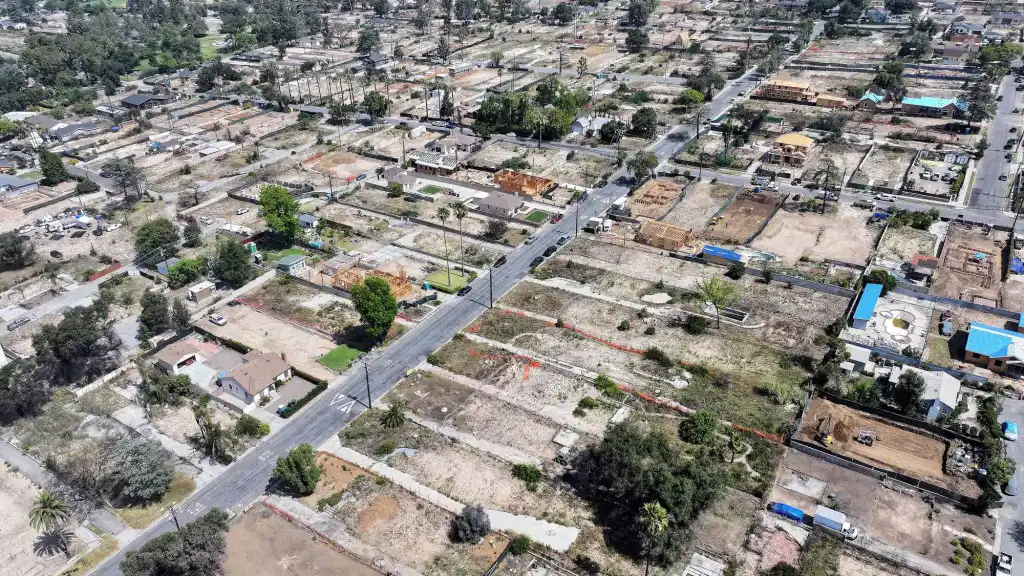
An investigation into delayed evacuation orders for residents west of Lake Avenue in Altadena during the first hours of the Eaton fire revealed that incident commanders did not intentionally delay those warnings or engage in misconduct, according to a report released Monday, May 18.
Read more Sunny Hills freshman golfer Jansen Baek wins CIF-SS Central regional title
Instead, fire officials were working with rapidly evolving fire conditions and had no assistance from air support as all aircraft had been grounded for the night amidst strong winds, the report says.
The investigation was initiated by the Los Angeles County Fire Department, which sought to analyze why evacuation warnings weren’t sent to residents in West Altadena until about 3:30 a.m. on Jan. 8, 2025, more than nine hours after the Eaton fire had started in the Eaton Canyon area. The investigation was initiated after a state-commissioned report released in November raised questions over the timeline of the alerts.
The investigation was done by Citygate Associates, LLC, which is based in Northern California. The agency’s 51-page report included analysis of interviews, operational records, dispatch information, incident communications and fire behavior during overnight hours from 9 p.m. on Jan. 7, 2025, to 6 a.m. on Jan. 8, 2025.
“The Altadena community deserves transparency, which is why I initiated this independent investigation,” Los Angeles County Fire Chief Anthony Marrone said. “While the report provides an honest account of our operations, we recognize that no investigation can truly capture the horror and tragedy residents endured. My focus is to ensure that the lessons learned from the Eaton and Palisades fires are turned into lasting changes that will better protect our residents and neighborhoods into the future.”
Included in the report’s 23 findings were that evacuation orders were not delayed, there was no evidence of any bias in evacuation decisions and that evacuation orders were issued before the fire crossed west of Lake Avenue, with the report noting the fire crossed the street just before 5:15 a.m., less than two hours after the first evacuation orders were sent to residents west of Lake Avenue.
The report also noted that previous reports of communications at 11:24 p.m. regarding expansion of evacuations in Altadena to La Canada could not be verified.
“A newly identified text confirmed those communications were focused on deteriorating conditions in Sierra Madre, not Altadena, and referenced two Sierra Madre Genasys Zones already under evacuation orders at 11:08 p.m.,” L.A. County fire officials wrote in a statement while making the report public.
The Eaton fire ignited amidst an uncommon wind storm in Eaton Canyon near high-tension electrical towers just past 6:15 p.m. on Jan. 7, 2025, and took a month to fully contain. During that time, the fire damaged or destroyed more than 10,000 buildings and claimed 19 lives, ultimately burning more than 14,000 acres from Sierra Madre to Altadena and in the western San Gabriel Mountains.
Though the cause has not officially been determined, the U.S. Department of Justice in September filed a lawsuit against Southern California Edison seeking more than $40 million in damages for the Eaton fire while claiming an Edison power line was the source of the blaze. The $40 million is the money that the U.S. estimated it spent on fighting the blaze and for damages to federal property.
Read more Lake Tahoe boat tragedy: Victims chose not to put on life jackets as water began to fill vessel
Dozens of community members have also filed lawsuits against Edison.
But many in west Altadena told the Southern California News Group that they did not receive alerts to evacuate until 3 a.m., with some saying they got an alert at 5 a.m. the morning of Jan. 8. The state-commissioned report noted calls of homes on fire in west Altadena before that time.
The investigation found that by 1 a.m. on Jan. 8, 2025, “Incident Command was still blind to the fire’s movements above them in the canyons,” and that from where operations was located, the “fire front on the ridge between Eaton Canyon and Rubio Canyon was 1,200 vertical feet above; there was no way to see or estimate fire spread.”
It found that all radio reports from 2 a.m. to 2:18 a.m. were identifying fire on the mountains and entering the edges of northern Altadena, the report says. The process of expanding the evacuation orders and warnings west of Lake Avenue began at 2:18 a.m., with the messages going out at 3:25 a.m.
Using FireGuard data, the investigation found the fire was still about two blocks east of Lake Avenue at about 3:53 a.m. and that the fire front extended one block west of Lake Avenue between Concha Street and East Los Flores Drive just before 5:15 a.m., the report says.
“The residents of Altadena and surrounding communities experienced immense fear and loss during this devastating event,” County Supervisor Kathryn Barger said in a statement following the release of the report. “Many continue to have difficult and deeply personal questions about evacuation timing and emergency notifications. Those concerns deserve to be taken seriously and carefully reviewed.
“This investigation should not be interpreted as dismissing the experiences of residents,” she continued.
The Los Angeles County Fire Department said it has accepted Citygate’s findings and recommendations, including developing alternative intelligence processes when aircraft cannot fly. The department has also integrated new technology and new units and teams, and is seeking a new 911 Computer Aided Dispatch system and is piloting OroraTech to provide real-time satellite imagery to detect and track wildfires, including ember cast.
Lastly, the department says it “supports assigning a dedicated technical specialist responsible for incident intelligence during challenging wildfires.”
Read more As enrollment falls, old schools find new life as apartments