
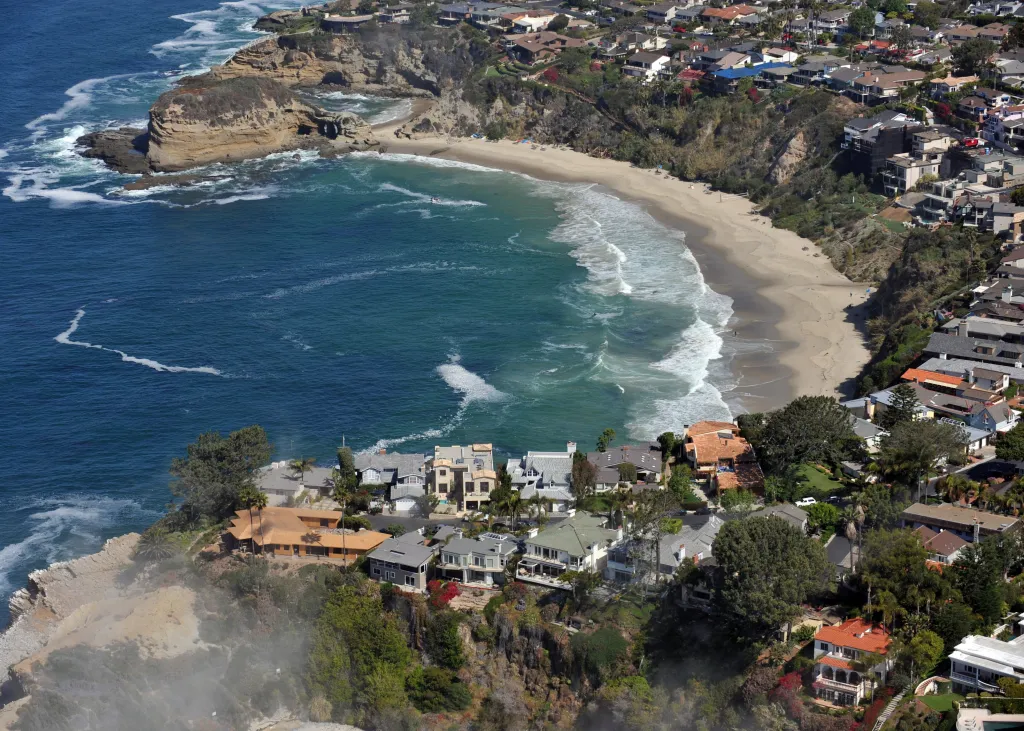
An effort by a Laguna Beach environmental group to protect a “final mile” of the city’s coastline by extending its marine protected area status to limit fishing will be up for public discussion and input at a regional meeting of the California Fish and Game Commission on Tuesday, May 19.
Read more More than a half-billion dollars later, just a dent in homelessness
The meeting in San Clemente will provide commissioners with an opportunity to hear from the public and stakeholders on the proposal, though the commission will not make a decision at this time. Several petitions related to MPAs along the state’s coastline will go before the Ocean Protection Council in June, which is expected to make a broad-based recommendation. The commission is expected to then make a final decision.
“This is a really important opportunity for dialogue of the pros and cons of who benefits and who pays the costs,” said Melissa Miller Henson, executive director of the Fish and Game Commission.
The petition by the Laguna Bluebelt Coalition has already been reviewed by the California Department of Fish and Wildlife, which earlier this year in a 19-page report rejected the proposal, saying there is no scientific evidence extending the local protected area to include South Laguna Beach to the Dana Point border would “meaningfully advance the goals of the MPA” and specifically bucked the coalition’s arguement that the proposal would significantly benefit migrating whales, improve kelp forest health, reduce whale entanglement risk, or enhance enforcement, and may in fact create new enforcement challenges due to less clearly defined boundaries.
Last week, the Laguna Beach City Council declined to throw its support behind the petition, agreeing with the department’s finding that “the science isn’t there.” Councilmembers agreed to send a letter from Mayor Mark Orgill suggesting that the city and its stakeholders “collaborate on opportunities to improve ocean health.”
The city’s environmental committee had previously come to the same conclusion, noting that the city’s coastline already benefits from nearly eight miles of protected habitat. Committee members also emphasized that the existing protected boundaries were the result of compromises made with local fishing communities.
The California Fish and Game Commission is the primary decision-making authority for the state’s MPA network and works with the wildlife department to manage the marine resources. In all, there are 124 MPAs designated statewide; 50 are off Southern California. They were created to help restore heavily fished and impacted sections of the California coastline.
The proposed extension of protections — the Bluebelt has gathered 6,000 signatures of support — would affect 1.32 square miles of beach and ocean between Table Rock and Three Arch Bay and make it so that fishing or taking any sea life, rocks or such in those areas would be prohibited as it is along the rest of Laguna Beach’s shoreline.
Local commercial sportfishing charters, lobster fishers, and recreational fishers have opposed the petition, saying the loss of access would further reduce the areas they can fish along the Orange County coastline and would negatively affect their livelihoods and the legacy of living from the sea.
In its review, the wildlife department said that the current boundary configuration was intentionally designed to balance ecological protection with human use, and that existing data do not support claims of enforcement confusion, ecological degradation, or management gaps.
Tuesday’s meeting will include a presentation by the Bluebelt Coalition and a review of the department’s findings, as well as take public and stakeholder input.
Mike Beanan, co-founder of the coalition, expressed disappointment with the Laguna Beach council’s decision, saying that his group has presented “scientifically sound information” and, at the council’s request, funded an independent survey by the Reef Check Foundation, an international nonprofit group dedicated to the conservation of tropical coral reefs and temperate kelp forests. He also added that in 2009, at the outset of the MPA efforts in the city, former mayor Toni Iseman and the council then supported full protection for Laguna Beach’s coastline.
Researchers from the coalition argue that protecting the “final mile” of coastline could significantly improve reefs off Thousand Steps Beach and Three Arch Bay.
“The science clearly shows full protection results in better habitat and more fish for all,” Beanan said, adding that the study compared South Laguna with the protected areas in Laguna Beach.
“You have received the Reef Check findings that confirm the reefs off Thousand Steps and Three Arch Bay have lost their historical kelp forests, likely due to overfishing keystone sea urchin predators such as male sheepshead,” he told the City Council last week. “Routine fishing by commercial day boats with dozens of fishermen has predictably removed the biggest and most beneficially reproductive fish.”
The coalition-commissioned study done in January — not included in the DFW evaluation— said that outside of the MPA areas off Laguna Beach, fishing for sheephead and spiny lobster had caused purple and red sea urchin populations to explode, which overgraze the kelp and decimate the kelp forests. On the other hand, the study found that inside the town’s MPAs, giant kelp densities remain highly stable and significantly healthier, thus proving that marine protections effectively balance the food web.
Beanan also points to kelp studies done by marine biologist Nancy Caruso, who for more than a decade has restored kelp forests along the Orange County coastline, which indicate a loss of kelp at Thousand Steps Beach. On a recent dive, Caruso reported finding “one kelp plant and a few fish and red urchin on the reef along with other species of algae.”
“I don’t see those urchins out and about in the reserve,” she added. “I don’t know why the kelp isn’t there; that’s why I’m studying it. The last time it was there was in 2014, in advance of the heat wave. A healthy ecosystem can withstand stresses, and our marine reserve did that right next door.”
Beanan said he remains optimistic about his group’s efforts and that the California Fish and Game Commission “will eventually approve the petition for citywide sea life protection based upon sound science and community support.”
“The process is not over,” he added, referring to the Ocean Protection Council’s review in June.
But, Casey Parlette, a former Laguna Beach lifeguard and commercial diver, who now sculpts marine and other wildlife and exhibits at the Festival of Arts, was among more than a dozen at the Laguna Beach council meeting asking that the council not support the petition.
“We all want the same thing, a healthy ocean for our marine life,” he said.
“My love started from years of free diving, spear fishing, and diving for lobster,” he said. “South Laguna has the only clear water to get in and dive, please don’t take that away from the next generation.”
The meeting starts at 8:30 a.m. and will be held at the Holiday Inn Express, 35 Via Pico Plaza in San Clemente.
Read more 2026 Point In Time Count: Orange County’s homeless population down 14% in two years