
Our survival depends on water. And, in California, our water supply depends heavily on dams.
Read more HOA Homefront: When must the board reduce assessments?
They store the stuff. They generate electricity. They reduce flood risk. And they are, on average, older than your grandmother and potentially far more dangerous.
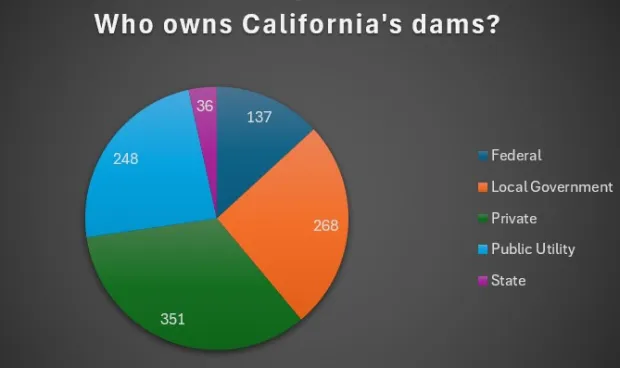
California has more than 1,200 dams, according to data from the National Inventory of Dams kept by the U.S. Army Corps of Engineers. Their average age is about 77. And the majority of those dams have what the engineers describe as “high hazard potential,” while another 165 carry “significant hazard potential.”
Don’t panic (yet). Those labels refer to the amount of mayhem they’d cause if they failed, not to their actual conditions.
So, what are their conditions, you ask?
As of their last inspections, according to USACE data on more than 1,000 of the dams:
— Three dams (including one in San Diego County) were in flat out “unsatisfactory” condition.
— 51 (including three each in Orange and Los Angeles counties, one each in Riverside and San Bernardino counties, and four in San Diego County) were “poor.”
— 93 (including one in Orange County, two in San Bernardino County and four each in Los Angeles, Riverside and San Diego counties) were “fair.”
— 744 were “satisfactory;”
— And, perhaps concerningly, 149 (including 11 in Los Angeles County, four in Orange County, six in Riverside County, seven in San Bernardino County and one in San Diego County) were “not rated,” or their conditions were “not available.”
We’re digging into all this because of a nudge we got from Julia, a reader in Fountain Valley, who lives near the Santa Ana River.
She’s wary about predictions of a very severe El Nino that could drench us next winter.
“I haven’t paid for flood insurance for more than 20 of the 45 years I’ve owned my home. Should I consider buying flood insurance in January when my homeowner’s insurance policy renews? I was quoted $1,400/year about four years ago,” she told us.
“When I researched this question myself in the 1980s, I was told by the city the danger would not be a breach two blocks from me but general flooding coming from Anaheim Hills and oozing through the county. I am sure a lot has changed since then.”
While we news types aren’t quite qualified to offer advice on whether to buy or skip flood insurance, we can share what experts say, as well as information to help you decide.
We can also ask the folks who own/operate the creakier dams what the heck is going on. Who knew there were so many dams in California? And that they’re so old? And that private entities own the largest single slice of them?
And that the federal numbers and state numbers on all those dams are a bit out of whack?
The California Department of Water Resources oversees state dams and counts 1,221 — including 1,076 deemed satisfactory, 87 fair, 56 poor, one unsatisfactory and one not rated — under its jurisdiction, spokesman Jason Ince told us.
“Ageing critical infrastructure, including dams, is a major issue across the country,” he said by email. “The California Department of Water Resources has established the Dam Safety and Climate Resilience Local Assistance Program, supported by $464 million from Proposition 4, to provide funding for repairs, rehabilitation, enhancements, and other dam safety projects at existing state-jurisdictional dams.”
The department also works with county emergency response agencies before and during flood season “to ensure coordination and communication,” he said. “California’s ongoing partnerships (with) the Scripps Institution of Oceanography and collaboration with the U.S. Airforce, NOAA and the U.S. Army Corps of Engineers have rapidly advanced research into extreme atmospheric rivers, giving emergency response agencies more time and information to coordinate deploying resources and issuing advanced evacuation warnings when flooding does occur.”
Which is encouraging.
But the basis on which most dams were designed, and are currently operated, includes outdated assumptions about hydrology and earthquakes, the Public Policy Institute of California said in a study. Scores need major upgrades to better handle large floods or withstand earthquakes.
Promising efforts are underway in some watersheds — including the Russian, American, Santa Ana and Yuba Rivers — to update operations using advanced weather forecasting technology, the PPIC said. But there’s much to do.
Condition: Poor
In Orange County, there are 36 dams with “high” hazard potential and one with “significant” hazard potential, according to the federal USACE data.
But only three local dams are in “poor” condition. These are the Santiago Creek dam, owned and operated by the Irvine Ranch Water District; the Lake Mission Viejo dam, under the auspices of the private Lake Mission Viejo Association, Inc.; and the Dove Canyon dam, operated by the private Dove Canyon Master Association.
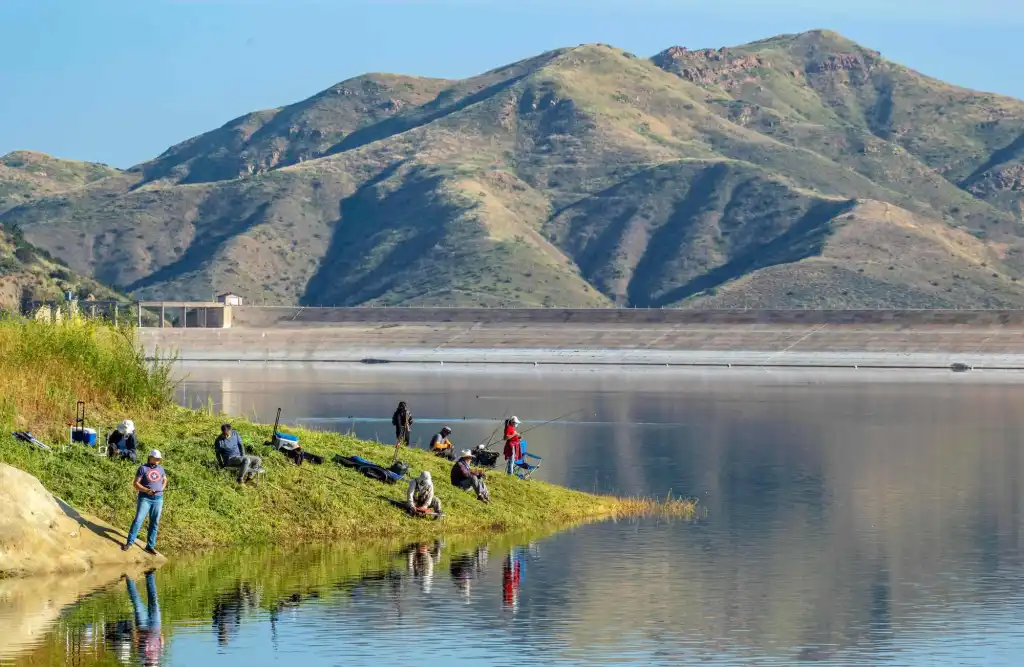
At 93, the Santiago Creek dam is the county’s grand dame, if you will. It was completed in 1933, stands 136 feet high and 1,425 feet long. It gives us Irvine Lake, a popular spot for fishing and playing. But it’s main purpose is water storage, making it “a vital part of Orange County’s water infrastructure” for central and southern O.C.
The Irvine Ranch Water District is working on it, and has launched an improvement project for the dam. A recent assessment found “the engineered earthen embankment dam is still operational but could be made safer,” IRWD said in its project summary.
“We also found that the outlet tower and spillway are reaching the end of their useful life and need to be replaced and upgraded to today’s seismic and safety standards.”
Read more WHO chief says Ebola outbreak in Congo is ‘spreading rapidly’ and upgrades risk assessment
Design on the project began in 2020 and it was slated to last, er, seven years. Construction is set to begin in 2027 and wrap up by 2030. It will cost
“We keep the water level at Irvine Lake lower to ensure public safety, and the (state) reviews and approves all decisions related to the dam,” said Irvine Ranch spokesperson Deniene Rivenburg. “Irvine Lake is an important local water source for 900,000 people in Orange County, and a popular recreation spot for the region. The project will keep the reservoir in operation for another 100 years.”
The Lake Mission Viejo dam at Oso Creek is much newer, completed in 1976. It’s 123 feet high, 1,750 feet long and more than 70 feet deep near the dam, with an overall average depth of 30 feet, according to The Lake Mission Viejo Association (which owns, operates and manages the Lake, dam and marina facilities, according to its web site). The dam creates Lake Mission Viejo, which holds about 1.2 billion gallons of water.
There are no structural issues with the dam, officials stressed. Instead, the dam’s “poor” rating is a function of three aging valves designed to release water from the lake. Inspection reports said they’re inoperable, but that’s not really the case, we were told; they’re just manually cranked, and have been sitting in water for nearly 50 years, and have gotten harder to operate. They’ve never had to be used in an emergency.
One valve has been replaced. A larger one is being re-engineered to open and close with the push of a button rather than the turn of a crank, and it should be in place by the end of the year. A third valve also is being worked on. There’s nothing to worry about, officials said; work is under way.
When you’re a dam owner, an official told us, you have the fun responsibly of getting the dam inspected and permitted every year, which costs some $45,000. You hire folks to read the instrumentation, measure soil movement and compaction, etc. “We’re doing everything right,” he told us. “When someone built this 50 yeas ago, they must have thought, ‘This is going to be somebody’s problem in 50 years, but it won’t be ours.’ “
Meanwhile, the Dove Creek folks told us that they thought the dam belonged to the water district, and we didn’t get more detail by deadline. (Because they’re sensitive infrastructure, dam inspection reports are only available through public records act requests, which takes more time than we had for this story.)
Anyway, that dam is 88 feet tall, 700 feet long and was built in Trabuco Canyon in 1989, forming Dove Lake. The gated community is designed to provide a sense of peace, its web site says: “Along with acres of trees and greenbelt, there are miles of nature trails, panoramic views of the mountains and a neighboring 16-acre lake, a large community pool, multiple tennis courts, and membership opportunities at the private Dove Canyon Golf Club.”
One dam, Rattlesnake Canyon, was in “fair” condition, while the condition of four others –Brea, Brea-Saddle Dike 1, Carbon Canyon and Fullerton — was not available.
Other SoCal counties
Los Angeles County has 81 dams with “high” hazard potential and six with “significant” hazard potential.
Three — Castaic, Century and Rubio Debris Basin — are in “poor” condition.
Four — Bouquet Canyon, Eagle Rock, Pyramid and Sawpit Debris Basin — are “fair.”
Sixty-nine others are “satisfactory,” while 11 are “not available:”
In Riverside County, there are 44 dams deemed to be “high” hazard potential and two deemed significant. Only one — Lee Lake — is in “poor” condition.
Four — Dam Lake Norconian South, Dam Lake Norconian West, Mcvicker Canyon Debris Basin and Vail — are in “fair” condition: Thirty-five are in “satisfactory” condition, while five are “not available:” One — Hall Mill — is not rated at all.
In San Bernardino County, there are 38 dams deemed high hazard and five deemed significant. Only one — Lake Arrowhead — is in poor condition.
Two — Cedar Springs and Glen Martin — are ranked “fair,” while 5 were not available and 2 are not rated. Another 33 are in satisfactory condition.
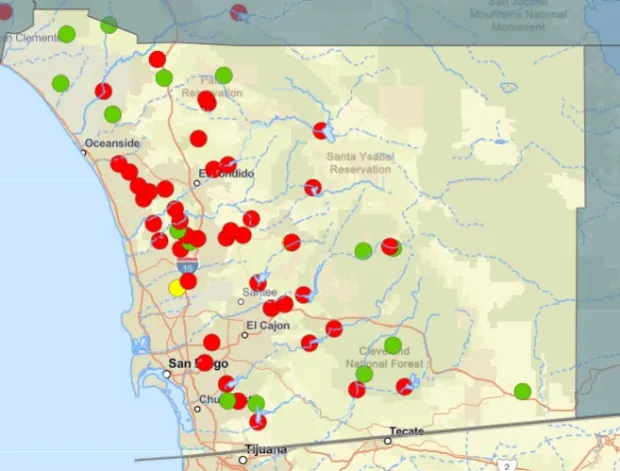
And San Diego County, which has 42 dams deemed “high” risk and two deemed “significant,” also has Southern California’s only “unsatisfactory” dam, Lake Hodges.
Four others — Barrett, El Capitan, Morena and Savage — are in poor condition. And another four — Lake O’Neill, Lake Wohlford, Murray and Sweetwater Main — are in fair condition. Thirty-four are in satisfactory condition, and the rating for one — Waste Pond — is unavailable.
Flood insurance?
To buy or not to buy, that is the question.
You might want to start by putting your address into the FEMA Flood Map Service Center at https://msc.fema.gov/portal/search and seeing if sloshy blue covers your property (it did for mine): But the advice is probably going to be, buy flood insurance.
“Whether you are in a high risk zone or not, you may need flood insurance because most homeowners insurance doesn’t cover flood damage,” . “If you live in an area with low or moderate flood risk, you are five times more likely to experience flood than a fire in your home over the next 30 years.”
We were steered to the First Street Foundation’s Risk Factor tool to get a “flood factor” score between one and 10, based on our address. Five or higher is basically “run for the hills.” Turns out my house is an eight. Ouch.
Just one inch of water can cause roughly $25,000 of damage to a property, and most homeowners and renters insurance policies don’t cover flood damage, FEMA says. And unexpected flood events — such as ponding or sewer backup — can happen far from waterways.
There’s also a “don’t lean on me” warning: It’s best not to bank on FEMA and federal disaster aid to bail us out, FEMA says, as the president must declare a disaster to set aid in motion, and it usually comes as a loan that must be repaid with interest.
So, when all is said and done, we’re not sure dams pose the greatest risks in a Super El Nino scenario; we already have enough mudslide, landslide and regular flooding risk to go around. If you want protection, inquire about flood insurance through your regular insurance agent and/or insurer, as well as at the (quotes at https://www.floodsmart.gov/policy-quote).
Word to the wise: Flood insurance policies often require a 30-day waiting period before kicking in. So if you’re worried about an uber-wet winter, you might want to get cracking. The roughly $1,400 quote for $200,000 coverage on building and $75,000 on contents seems to hold true.
Please see the online version of this story for an interactive map with information on all of California’s dams from the USACE.
Read more Advocacy group sues Trump administration over access to abortion for veterans
And, Julia, we hope this helped.