

Californians are a bit pessimistic these days.
They’re dissatisfied with the overall state of California, with how President Donald Trump and Gov. Gavin Newsom are handling their jobs and with the outlook for their personal finances.
Read more Advocates celebrate 230th anniversary of Ona Judge’s escape from enslavement by George Washington
That’s all according to a recent statewide poll from the New California Coalition. The nonpartisan organization surveyed 1,529 people considered likely to vote in the 2026 midterm elections to get a sense of their mood heading into the primary, how they view the economy and elected leaders and what they’d like to see the state address when it comes to artificial intelligence.
Perhaps predictably, affordability tops the chart for the issues likely voters care about as the June 2 primary barrels closer.
Addressing inflation and the rising cost of living was the No. 1 priority for voters surveyed.
Voters were presented with a lengthy list of issues and asked to score them on a scale of 1 to 7, with 7 designating an issue was extremely important.
Based on median scores, addressing the rising cost of food, gas and other essential goods, and reducing the tax burden on California working- and middle-class families were among the top five issues.
But sandwiched at Nos. 2 and 3, respectively, were maintaining a safe and reliable supply of water and increasing transparency and accountability to reduce waste, fraud and abuse in state and local government.
Maintaining a reliable supply of safe and affordable energy also made the top 10 priorities for likely voters surveyed.
Affordability and water supply have continued to top the list of issues likely voters care about, said New California Coalition’s survey, which has been polling residents since 2022.
Maintaining a safe and reliable supply of water, in fact, was the No. 1 issue in 2023.
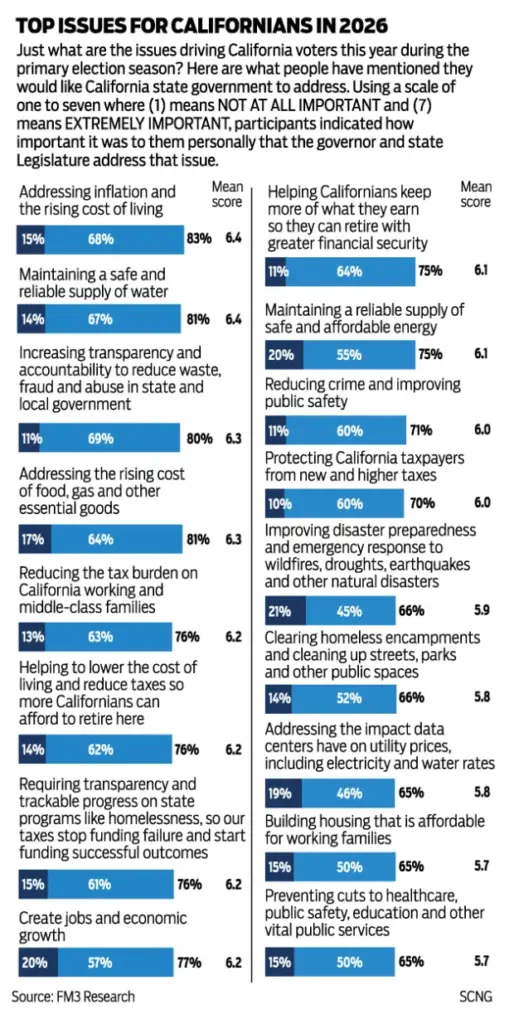
In the latest survey, issues that could be viewed through a more partisan lens — addressing climate change and protecting the environment, reducing income inequality by raising wages for workers and protecting the rights of undocumented immigrants and their families — closed out the list of important issues.
When it comes to the direction California is headed, 59% of those surveyed in April said the state is on the wrong track, an increase from the summer of 2025 when that number was at 56%. This year, 27% of those polled said the state was headed in the right direction, compared to 28% in 2025.
In August 2022, 55% of people surveyed said California was on the wrong track, and 36% were optimistic.
Newsom, who is in his final term as governor, also saw his unfavorability score increase this year; 58% of those surveyed had an overall unfavorable impression of the governor, while 41% viewed the Democrat favorably.
In the summer of 2025, 45% of survey respondents had a favorable impression of Newsom, and 52% were unfavorable.
Trump fares even worse.
This year, 64% of likely voters held a negative view of the Republican president, and only 35% viewed him favorably. Last year, 62% were unfavorable, and 36% were favorable.
Read more NASCAR’s Kyle Busch was short of breath, coughing up blood day before his death, 911 call reveals
Comparing California’s two U.S. senators, Alex Padilla and Adam Schiff, both see similar favorability scores: 36% of respondents view Padilla, the senior senator, favorably, as do 35% of respondents for Schiff.
But when it comes to unfavorability, likely voters have a stronger opinion about Schiff, the former congressman: 47% of those polled view him in a negative light compared to 35% for Padilla. Padilla’s numbers hold similar in 2025, but only 36% of those polled last year viewed Schiff unfavorably.
Also scoring relatively low: California’s economic outlook. Only 18% of those surveyed said California’s economy will get better in the next couple of years, and 46% said it will get worse.
That’s slightly better than last year, though, when 17% of survey respondents were positive and 58% were negative.
Predictions about personal finances weren’t much better. Only 21% said they thought their personal financial situation would get better in the next few years, while 45% said it would get worse.
Last year, 23% were optimistic, and 40% were not. And in 2023, 29% of those surveyed said they thought their financial situation would be better, and only 37% were pessimistic.
So what does all that mean for the 2026 election?
Matt Lesenyie, an expert in political psychology and California politics who teaches at Cal State Long Beach, likened it to box office sales. Voters, Lesenyie said, aren’t excited about this movie, and they aren’t going to show up to see it.
“Voters, for as engaged as they are, I don’t feel that the political rhetoric is meeting the moment,” said Lesenyie. “That’s apparent to voters. What’s on the menu will not solve their problems, at least in the short term.”
Candidates, particularly those who are running for governor, shouldn’t shy away from critiquing current leadership, in either party, to show voters clearly how they would bring change and be different, Lesenyie said.
“I’m not really seeing that,” said Lesenyie.
And that’s not going to help voters’ attitudes — or drive turnout this election cycle.
“The legacy is protected, but the election is lost,” he said.
Some other highlights from the New California Coalition’s study:
• Nearly three-quarters of those surveyed said they would like California to adopt stronger laws to regulate how technology companies use artificial intelligence.
• 42% of those surveyed said they prefer younger candidates, under the age of 40, who “will take on the political establishment to fight for change, even if they take extreme stands on issues.” Meanwhile, 33% preferred someone who is over the age of 60, who is a “moderate and tries to work across party lines,” even if they have been in political office for nearly all of their career.”
• Younger voters (18-39) were more likely to pick housing as their No. 1 priority, while older voters (over 60) picked “fighting Donald Trump” and “the state’s water and energy supply” as their main priorities.
More than 1,520 people considered likely to vote in the 2026 midterm elections were surveyed by FM3 Research in mid-April, both online and in phone interviews and in English and Spanish. The poll has a margin of error of +/- 2.5%. Other surveys were taken in August 2022, October 2023 and July and August of 2025.
Read more World Cup co-host Mexico traces its soccer roots to miners from Cornwall