
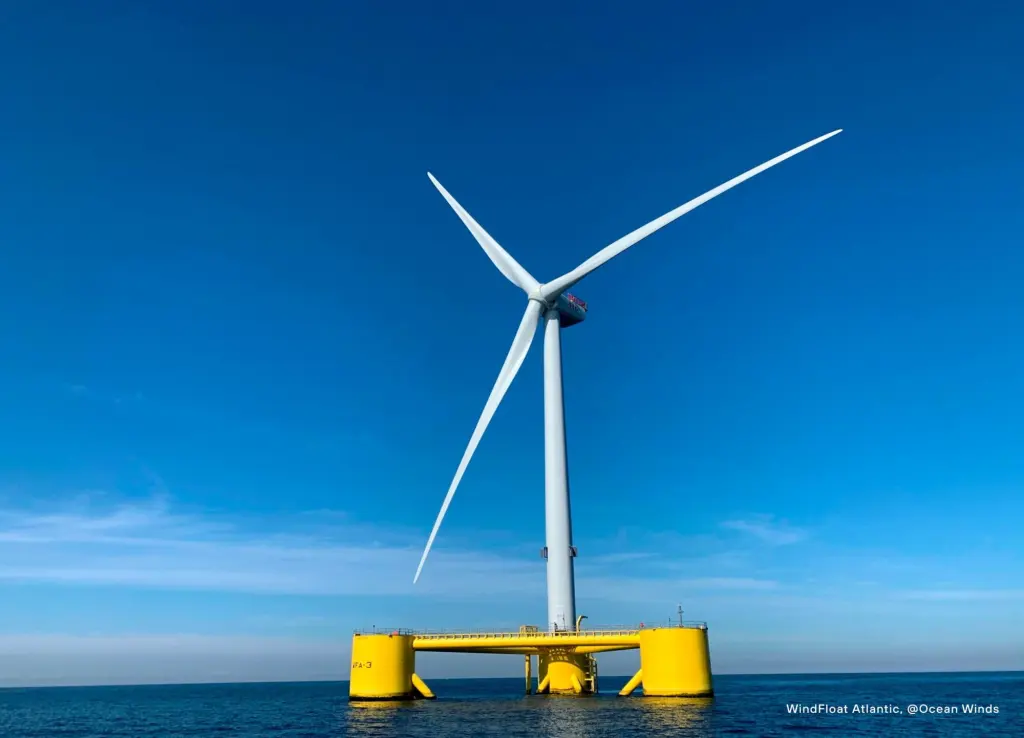
California is counting on the growth of offshore wind generation to help the state meet its ambitious goal to derive 100% of its electricity from carbon-free sources by 2045 or earlier.
Read more What do Californians care about this election cycle? New poll breaks it all down
But late last month, state energy officials and offshore-wind advocates were blindsided after learning one developer abruptly withdrew plans to build a big wind farm in Morro Bay, after striking a controversial deal with the Trump administration.
It came “totally out of the blue,” said Matt Baker, one of the five voting members of the California Public Utilities Commission, “and it’s amazing the lengths that the administration is going towards trying to make this important source of energy off-limits, both to California and the rest of the country.”
Baker was one of the panelists this past week in Long Beach at the Pacific Offshore Wind Summit, a meeting of policymakers, businesses, port authorities, environmental groups and others supporting the Golden State reaping the anticipated energy bonanza blowing off its coast.
The title of this year’s convention was telling: Staying The Course on California Offshore Wind. And state energy officials insist they can ride out the storm.
“I really want to invite us all to think about this moment and this enterprise we’re all engaged in, and actually get excited about how hard it is,” David Hochschild, chair of the California Energy Commission, said during the event’s keynote address. “It’s hard because it matters and if it were not important, it would have been done already.”
Hochschild reiterated the state’s commitment to produce 25 gigawatts of electricity from offshore wind farms by 2045. For perspective, the Diablo Canyon nuclear plant in San Luis Obispo produces 2.2 gigawatts of capacity, which accounts for about 9% of the state’s power mix each year.
“During this period where we have a federal administration that’s hostile to (offshore wind), the technology is still improving,” Hochschild said, “and we’re still investing heavily in that.”
Offshore wind in California is different
Offshore wind is in its infancy in California. In fact, the first facility has yet to “put steel in the water” and getting the projects done is more complicated than in other parts of the country.
Unlike the East Coast, where turbines can be bolted into the seabed, the continental shelf off the Pacific coast plunges steeply.
That means offshore wind farms in California will float on the water’s surface, tethered or moored by cables to the ocean floor. Electricity generated by turbines will be transmitted to a floating substation and carried to a power plant onshore via buried cables.
California is expected to be the first region in the U.S. to use floating wind turbines.
There are no plans to develop offshore wind generation in San Diego and Southern California. That’s in large part due to discussions years ago between military officials and the Bureau of Ocean Energy Management that ultimately designated Southern California a “wind exclusion” area because of concerns that offshore wind facilities would interfere with training missions.
Besides, wind speeds in the south are not as steady and strong as those in Central and Northern California. As a result, efforts to build floating offshore wind projects have focused on Morro Bay and Humboldt County.
“There’s a stretch between southern Oregon and Northern California, up to Cape Mendocino, that’s really one of the windiest spots along the U.S. coastline,” said Arne Jacobson, director of the Schatz Energy Research Center at California State Polytechnic University Humboldt. “I think the only place that’s similar is in the Aleutian Islands, so it’s just an enormously strong wind resource.”
Another plus, supporters say, is that offshore wind can complement solar on California’s power grid.
Solar production is abundant during the day but essentially drops to zero after the sun sets. However, electricity generated by gusts offshore is considered a reliable source of energy, especially during night-time hours.
While final designs for offshore facilities are still to be submitted, each turbine will soar as high as a 70-story building, with blades larger than a football field to harvest the maximum amount of wind. At a distance of at least 20 miles, the towers, the , are “not expected to be highly visible” from the shore.
What happened with the lease?
Back in December 2022, five companies collectively bid $751.1 million to win leases to build wind farms — three off the coast of Morro Bay in Central California and two in the waters of Humboldt Bay in Northern California. Each project, covering tens of thousands of acres, will be located at least 20 miles from the mainland, in federal waters.
But on April 27, the U.S. Department of the Interior announced that one of the leaseholders, Golden State Wind LLC, committed “to voluntarily end” its lease in Morro Bay. In exchange, the company will be eligible to recover $120 million in lease fees after spending an equal amount on U.S. oil and gas assets, energy infrastructure or liquefied natural gas (LNG) projects on the Gulf Coast.
The Golden State Wind project was expected to generate up to 2 gigawatts of energy, enough to power about 1.1 million homes.
The same day, Interior announced a similar deal to reverse plans to build a large wind farm off the coast of New Jersey and New York. Instead, the investors will spend their $765 million on an LNG facility.
“The companies that bid for these offshore wind leases were basically sold a product in 2022 that was only viable when propped up by massive taxpayer subsidies,” said Interior Secretary Doug Burgum, calling them “expensive, unreliable, intermittent” energy projects.
The California Energy Commission fired back, to Golden State Wind, seeking documents from the company about what Hochschild called “backroom deals that would turn back the clock on innovation.” California Attorney General Rob Bonta and the state’s Department of Justice have also jumped in.
“The state has made significant investments in developing offshore wind as a reliable source of clean electricity to help achieve California’s clean energy goals,” an energy commission spokesperson said in an email.
Asked by the Union-Tribune for a comment on the subpoena, a spokesperson for the Department of the Interior said via email that the agency does not comment on ongoing litigation, “however maybe (the energy commission) should investigate the reason oil refineries are shutting down in California including the state’s policy to import 63% of its oil from foreign countries like Iraq.”
Read more Advocates celebrate 230th anniversary of Ona Judge’s escape from enslavement by George Washington
Speaking at the Long Beach conference, Adam Stern, executive director of the trade group Offshore Wind California, said “these latest attempts to obstruct offshore wind are almost certainly unlawful and will likely be overturned either by the courts, Congress or the next federal administration.”
Stern called the lease buybacks “an unprecedented abuse of taxpayer dollars.”
The withdrawal by Golden State Wind comes on the heels of a similar move made two months ago, when the Department of the Interior announced a $1 billion deal with TotalEnergies of France to ditch offshore leases in New York and North Carolina and spend the money instead on an LNG project and oil and shale gas production.
Upon returning to the White House in January 2025, Donald Trump issued a review of leasing and permitting practices for all wind energy projects in the U.S. and called for a temporary withdrawal of all areas on the outer continental shelf from offshore wind leasing.
Trump’s opposition to offshore wind dates back to at least 2006, when he tried to block an 11-turbine facility off the coast of Scotland within sight of a golf course he built. He lost the case and was ordered to pay the equivalent of nearly $300,000 in legal bills.
In early March, Trump told a group of tech executives to invest in fossil fuels rather than wind energy. “Don’t worry about wind,” he said. “Forget it. It’s worthless.”
Various reactions to the lease walk-back
The development of floating offshore wind is a high priority for the Port of Long Beach — site of the proposed $5 billion Pier Wind terminal, a 400-acre facility that plans to stage, store and assemble massive wind turbines. When fully assembled, the turbines would be towed by barges from Long Beach to lease areas in Morro and Humboldt bays.
In light of Golden State Wind walking away from its lease, Long Beach Mayor Rex Richardson is taking the long view.
“You don’t stop because the future’s uncertain,” he told the Union-Tribune during a reception at the convention. “You acknowledge that this is a stage in a process, but there are many stages and many administrations to get through before this becomes a reality.”
The deep-water Port of Long Beach received a $20 million grant last fall from the California Energy Commission for design and construction work at Pier Wind. It came as a part of Proposition 4, approved in 2024 by California voters, which set aside $475 million for port infrastructure projects connected to offshore wind development in locations across the state.
“We’re not going to turn back … It’s going to take multiple administrations to see a project like this through,” Richardson said.
But some longtime opponents of offshore wind in California cheered the news.
“Our organization is happy that Golden State Wind has terminated their lease … and we are hoping that the other two lease holders on the Central Coast follow suit,” said Nicole Dorfman, board member and secretary of the REACT Alliance, based in San Luis Obispo.
Touting a mailing list of more than 800 on the Central Coast, the group worries the buildout of floating offshore facilities will harm the environment, marine life, birds and ocean floor, and industrialize the area.
“It’s not a small footprint by any means,” Dorfman said. “People care about the wildlife. We have southern sea otters in our harbor who are threatened, if not endangered. We want to protect them. An industrial port would lead to air, noise, light and water pollution.”
As for supporting the deal Golden State Wind struck with the Department of the Interior, Dorfman said, “REACT Alliance was in this fight well before the Trump administration came into office … If Kamala Harris had won and had done the same thing, we would also be grateful for it. It’s not a partisan issue at all for us.”
Dan Jacobson, senior adviser at Environment California, is a die-hard supporter of offshore wind development.
“We have to study where we put” the wind farms, he said. “We have to make sure that we’re not putting them in the path of seabirds or albatross or orcas. But all that can be done in such a way that we can have clean energy and a clean ocean, too.”
As for the withdrawal by Golden State Wind, Jacobson said, “We want the other four (leaseholders) to stay in and we think people will look back and say, ‘This was a real mistake that you made back then.’ “
The head of Brightlne Defense, an environmental group based in San Francisco, said the nascent industry is at “an inflection point” in California.
“Everybody can’t ignore the national picture for offshore wind and how these projects are getting disrupted,” executive director Eddie Ahn said. “What I want to make sure is that there are no more deals being cut, essentially reneging on what the communities that we work with originally saw as an intent to work in these areas and develop them.”
The meeting in Long Beach included a presentation by Turn Forward, a pro-offshore wind organization, that released results of polls in multiple states. In California, the of 615 registered voters reported that 76% favored offshore-wind construction. The poll had a margin of error of plus/minus 4%.
Hochschild of the California Energy Commission told attendees that he compares opposition from the Trump administration to turbulence the solar industry faced in the 2010s in the wake of Solyndra, the company that defaulted on a $535 million loan guaranteed by the U.S. Department of Energy.
“There were people ready to declare a funeral for the solar industry,” Hochschild said. “We persevered … and now solar’s the single biggest investment on the global electric grid, in excess of a half a trillion dollars. So my point is don’t listen to the naysayers. Keep at it. We’re gonna get this done.”
The California Independent System Operator, which manages the electric grid for about 80% of the state, on Tuesday approved its transmission plan that included projects it expects the state will need to handle anticipated load growth on the electric system in the next 10 years.
Among the infrastructure, the grid operator slated more than 4.5 gigawatts of offshore wind, with 2.9 gigawatts in Morro Bay along the Central Coast and 1.6 gigawatts in the North Coast/Humboldt.
Read more NASCAR’s Kyle Busch was short of breath, coughing up blood day before his death, 911 call reveals