
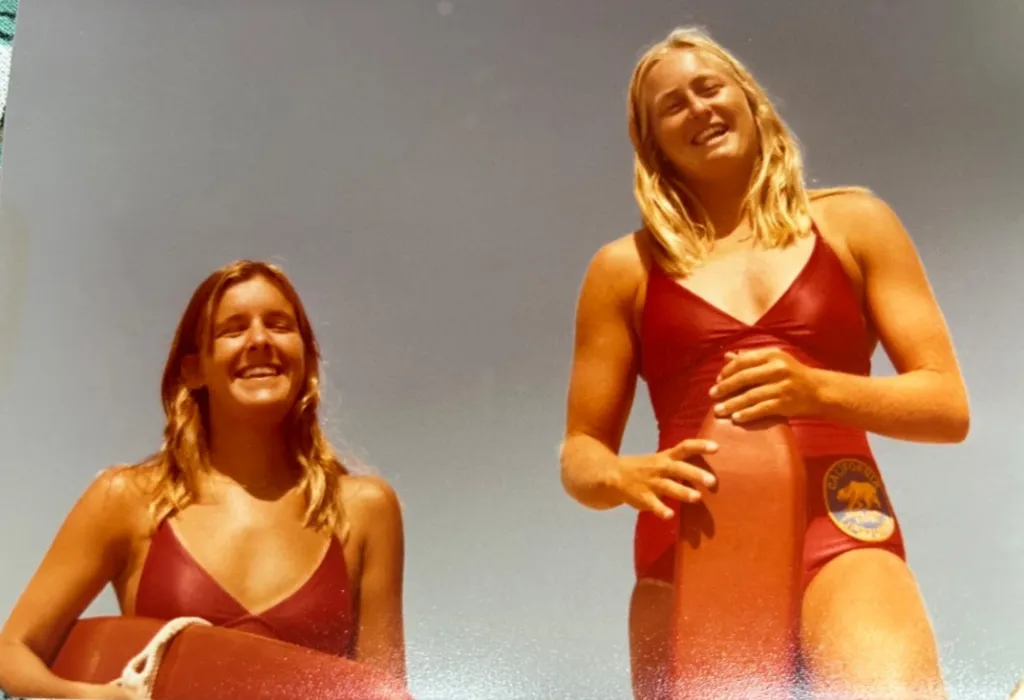
Debbie Friedman wondered if there was some kind of mistake.
She was a strong competitive swimmer from Mission Viejo who was urged by a fellow teammate to tryout to be a lifeguard.
Read more Britney Spears was ‘confrontational’ and ‘flamboyant’ but tested low for alcohol during DUI stop
Sounded like a good gig, with decent pay — so she thought, why not?
It wasn’t until she showed up on the sand at Huntington State Beach that Friedman realized she was the only woman among the 100 lifeguard hopefuls that chilly February morning in 1978, a milestone moment in not just her life, but women’s lifeguarding history.
“Where were the other women?” she wondered, as detailed in her recently published book “Guarded: Women, Water and Saving Lives.”
“Why am I the only one here? Did I make a mistake?”
As beachgoers head to the coast this holiday weekend, they’ll see a mix of men and women guarding the waters, rescuing people from rip currents and keeping them safe from other hazards in and out of the ocean.
But five decades ago, women “manning” the towers was an unlikely sight. It was a time when just a few females up and down the coastline were changing the profession — one stretch of beach at a time — and paving the way for future generations of women lifeguards.
Friedman will be in Orange County in coming days discussing her book, the first stop at 6 p.m. at Beach Town Books in San Clemente on May 27, followed by a talk at 1 p.m. on May 30 at Girl in the Curl surf shop in Dana Point — there she will be joined by the first-ever lifeguard and champion surfer Joyce Hoffman.
Friedman’s book details not just her own experience as the first permanent State Parks lifeguard and her years spent in San Clemente and Huntington Beach, but also those of others who braved the all-male professional ranks about the same time, including Hoffman, known as the first female lifeguard when she earned a summer job guarding the city of Del Mar in 1971.
Friedman, who finished her guarding career in 1990 and now calls Santa Cruz home, said she was surprised no book on the topic of early female lifeguards existed when she started exploring the idea of writing about her experiences.
She started contacting others she knew from the 1970s who broke barriers at beaches up and down the coast.
It was three years ago, while chatting with friend and colleague Mike Brousard, who authored the book “Warm Winds and Following Seas: Reflections of a Lifeguard,” that Friedman said she declared she was ready to write the book.
“I just blurted it out, ‘I’m going to write a book, for good or for bad,’” she recalled.
She spent a year interviewing women, realizing they were all eager to tell their stories, each uniquely their own.
“I was encouraged that my story reflected many women of this generation,” she said. “There was value in telling my own story, but I wanted to tell all the stories.
“The more I knew, there were no two stories alike. Everyone was different.”
Hoffman was an accomplished surfer going up against males in the ’60s and ’70s, and a celebrity in and out of the water, by the time Huntington Beach Chief Vince Moorhouse chatted with Del Mar Captain Gardner Stevens about allowing her to join the lifeguard ranks.
“It was a radical idea — revolutionary — especially for two men with traditional leadership roles in guarding,” Friedman writes in the book.
They had watched Hoffman, 23, win the U.S. Surfing Championships at the Huntington Beach Pier and knew she was more than capable in the surf.
“They didn’t see Joyce as a model for equality. Lifeguarding was a man’s world … Joyce was an anomaly, a curiosity among men,” Friedman writes. “If she could pass the lifeguard tryout test, it wouldn’t mean other women could do the job. It would simply mean Joyce could.”
The book details her tryouts in 1971, surrounded by men, reporters on the sand documenting the milestone moment, and her two summers of guarding at the San Diego beach as California’s first female ocean lifeguard before moving on to her next adventure.
“I felt a whole lot of womanhood pressure,” Hoffman is quoted in the book saying.
It was a similar feeling Friedman remembers a few years later during her tryouts and training.
“Personally, I didn’t know I was going to be the only woman on the starting line, the only one in training,” she said, speaking from her Santa Cruz home. “We were definitely unknown factors, being questioned regarding our strength.”
Los Angeles County’s first female lifeguard, Wendy Paskin in 1974, was required to sling a man over her back and carry him to shore to prove her strength, a test only given to her, not the other males trying for the same job.
“Somehow that became a rite of passage for women lifeguards,” Friedman wrote.
During Friedman’s rookie training in 1978, she faced the same test.
“All eyes were on me, the only woman. Half the class wanted to see me succeed, the other half wanted me to drop him, hoping for a car-crash moment with blood and guts,” she wrote, detailing how she carried the man to shore, set him down, adding that she’s never seen the carry rescue done in any real ocean rescue.
Read more South Pasadena home, remodeled and expanded by R.M. Schindler, seeks $2M
She didn’t write the book to be a list of grievances, she said, but wanted to put the readers in the women’s shoes, to illustrate what it was like to enter the uncharted waters of the time.
Some moments in the book, in today’s world, seem silly — like the men who worried about where the women would go to the bathroom, or change into uniform.
The women interviewed were generous in sharing their stories, Friedman said, to let readers know what it was like to be a woman in the 1970s, the sense of accomplishment, but also the fears.
Kim Raymont joined Friedman following training that first summer in San Clemente, developing a kinship so they had someone to turn to when they each needed support.
But many of the pioneers were going it alone.
“We were all isolated on our own beaches,” Friedman said. “There was no one exchanging notes.”
Friedman was lucky to have a group of men that supported them, but the story wasn’t the same at other beaches.
“There were still women for the first time being seen, and questioned, in the ’80s,” she added.
Lifeguarding has a huge learning curve no matter what the person’s gender, Friedman said.
“Most of the women I spoke to, we just wanted to do a good job,” she said. “We needed a mentor and the same support any rookie got.”
Friedman would be a lifeguard for about 12 years, moving up the ranks, and through the years helping to mentor other female lifeguards.
“I fell in love with lifeguarding,” she said. “I was just trying to move forward in a job and culture I loved.”
Brousard, who worked for State Parks for more than 40 years, remembers when Friedman and Raymont showed up on the sand for their lifeguard jobs in San Clemente.
“We were all freaking out about it,” recalled Brousard, who still lives in San Clemente and has stayed close friends with Friedman. “Our locker room at that time was a hive of sophomoric hijinks. We were afraid they would come in and put a damper on that.”
But it wasn’t long before the women proved themselves and the worries eased, he recalled.
“The biggest thing was they were rocket-fast swimmers,” he said. “For about a week, we were circling them, trying to figure out their story. They just did their job and did it well.”
By the end of the summer, at least in his eyes, they had been accepted and fit right in with the crew of other lifeguards.
“I know there are things they had to contend with I didn’t understand at the time,” he said, noting that within three years following Friedman and Raymont’s appearance, there were another six or seven women on staff.
“For us, at San Clemente State Beach, they fit right in,” he said. “They earned their place on the roster. They were great lifeguards. They paid attention and were not prone to doing the silly stuff the guys were known for — they took care of business.”
He chuckles at the stories of how, on several occasions, victims refused a buoy because their rescuer was a woman.
Several books in recent years, including two written by Brousard, have shared the lifeguard experience. But Friedman’s is the first to do it through the lens of a woman.
“This is a groundbreaking book,” he said.
Friedman has had book signings and gatherings in her hometown of Santa Cruz, but is excited, she said, for her appearances in South Orange County, where her story began.
“A world without women lifeguards seems crazy,” she said. “In my lifetime, it seems normal.”
Read more Trump proposal to eliminate ‘roadless areas’ in forests draws ire among Southern Californians