
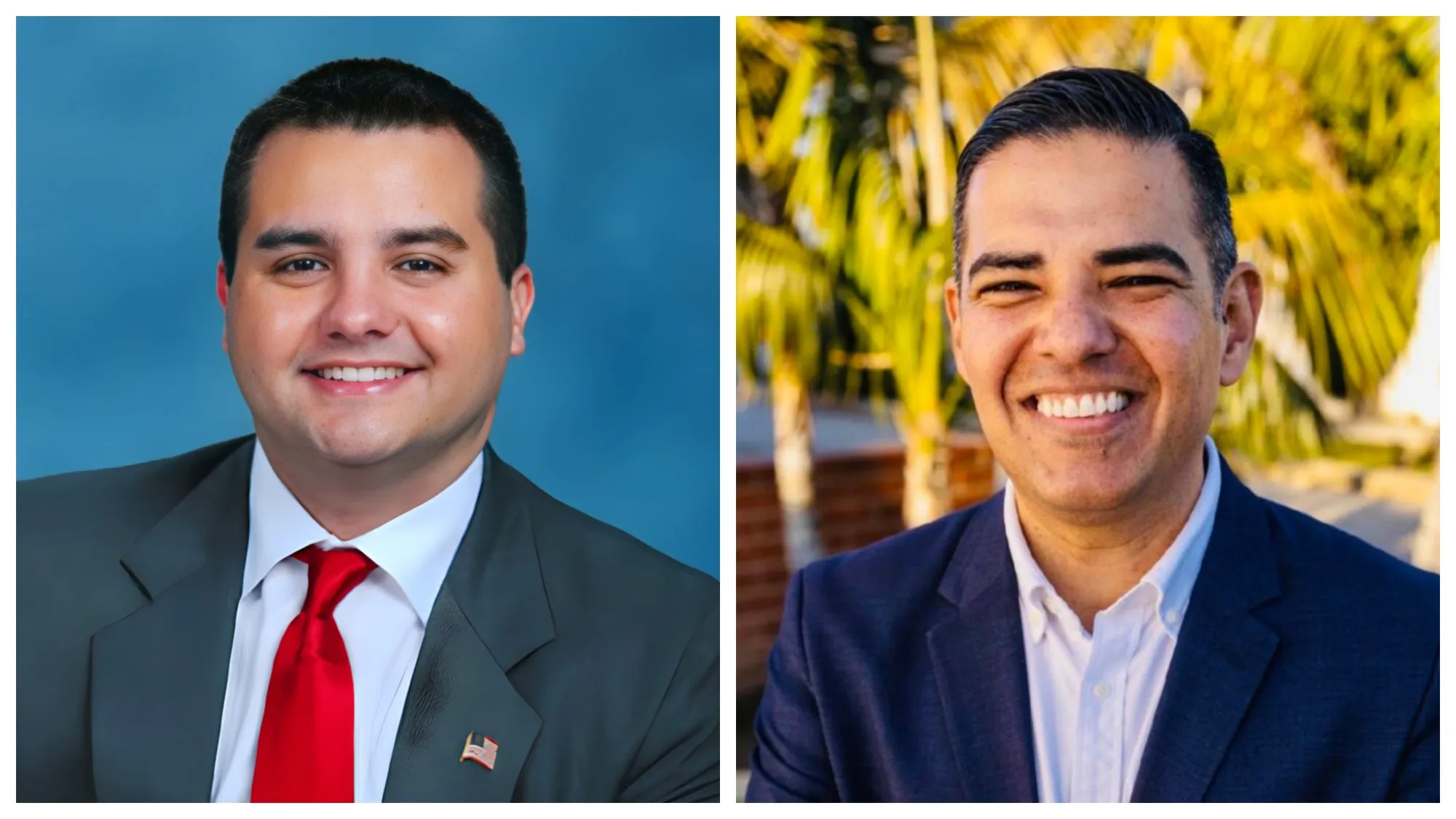
Although California’s 42nd Congressional District has a new look and new boundaries after last year’s redistricting, familiar names appear on ballots for voters across the district.
Read more US hits Bank of America with $1.2 billion fine, saying it violated money laundering, sanctions laws
Rep. Robert Garcia, a Democrat from Long Beach, is running for his third term representing the Long Beach area. He faces Brian Burley, a Republican who serves on the Huntington Beach City School District governing board and is also running for Huntington Beach City Council this year.
First elected to the post in 2022, Garcia, 48, is a former Long Beach mayor and councilmember who has quickly risen to leadership positions on Capitol Hill. For over a year now, the progressive Democrat has served as the ranking member of the House Oversight Committee, which serves as the primary investigative panel in Congress.
Burley, 33, also works in information technology and higher education in addition to his school board role. He has a degree in political economy from USC, where Burley also earned master’s degrees in public policy, digital media and emergency management.
As for the congressional post, to no surprise, both candidates see affordability as the top issue facing constituents in their district, which stretches from Newport Beach in Orange County to Long Beach in L.A. County. And while Burley and Garcia differ strongly on other issues, like immigration, they share common ground in others, like the use of surveillance technology.
“Congress cannot control every price, but it can stop making the problem worse. I will support responsible spending, tax relief for families and small businesses, expanded domestic energy production and fewer costly federal regulations,” Burley said in response to a questionnaire from the Southern California News Group.
Garcia, likewise, said Congress needs to support programs that “put more money in people’s pockets and lower costs,” cut red tape around housing development and expand job training programs for modern occupations.
When it comes to how the federal government could actually help make housing in California more available and affordable, Garcia said Congress needs to go after common-sense policies “like streamlining regulation and cutting red tape” to tackle housing shortages.
“Policies like ending the tariffs on building materials, which make it impossible to build cheaply,” Garcia said. “Irresponsible tax cuts for large corporations and spending on a disastrous war have made mortgage rates higher, pricing more families out of the ability to buy a home. But we also have to get tough with big corporations that drive up the price of homes or treat consumers unfairly.
As for housing affordability, Burley pointed to a specific program he would try to expand if voters elected him in November: mortgage credit certificate programs for first-time homebuyers. These local and state-run programs let homebuyers claim a dollar-for-dollar federal tax credit for part of the mortgage interest they pay each year.
“Congress should provide dedicated capacity for these certificates, modernize eligibility limits for high-cost areas such as Southern California and make the benefit easier to access when purchasing a home,” he said.
Surveillance technology
Concerns about the use of surveillance technology have intensified recently, often relating to license plate readers made by Flock Safety.
Proponents of the technology tout its ability to improve the operations of law enforcement. But opponents say these tools create mass surveillance systems that infringe on an individual’s right to privacy.
The public’s concern over how this technology is used — and abused — is not unfounded, Garcia said.
Garcia said he is leading investigations through the House Oversight Committee into how Flock Safety handles data it collects and into how to better protect the privacy of U.S. citizens, and how that privacy conflicts at times with the collection of this data.
Read more Fountain Valley football rebuilds confidence to snap league losing streak
“Last year, we received alarming reports that Flock’s automatic license plate reader (ALPR) system, marketed as a public safety tool, has been exploited to track people across state lines and to conduct unauthorized immigration enforcement,” he said. “(The House Oversight Committee’s) work has already helped push Flock to improve their practices, but far more is needed. This issue will be a priority for Oversight Committee Democrats in the next two years.”
Burley felt just as strongly about the use of these products. He said the use of Flock and other surveillance technologies has “gone too far.”
“Americans should not be subjected to constant surveillance simply because they are in public. These tools should be limited to targeted public-safety investigations, with warrants generally required, strict data-retention limits and safeguards against misuse,” Burley said. “Congress must ensure that technology supports law enforcement without sacrificing Americans’ constitutional right to privacy.”
Immigration
The two candidates greatly varied on how they think U.S. immigration policy should look in five years.
Burley said in a half-decade the U.S. “should have permanently secured borders and zero tolerance for illegal immigration.” He praised the federal immigration enforcement efforts since President Donald Trump took office early last year.
But it will be on Congress to make these policies permanent, Burley said, “so a future administration cannot simply reverse them.”
“I will support continued border enforcement, completion of the border wall, nationwide employment verification and stronger action against sanctuary jurisdictions,” Burley said. “America must never return to open-border policies.”
Garcia’s views on immigration stand in contrast. As an immigrant from Peru, Garcia said he strongly believes in “a secure border and enforcing our immigration laws,” but how the Trump administration has carried out immigration enforcement “is inhumane and must be changed.”
Any immigrant who comes to the U.S., works hard and follows the rules “should have the same opportunities I did,” Garcia said.
“I also strongly believe that our government should provide a clear pathway to citizenship to the people who have come to this country and have been good members of society,” he said. “Immigrants are some of the most patriotic people in our country, and make our communities stronger, richer and safer.”
In the 42nd Congressional District, registered Democrats make up 40.65% of the voters (194,164), . Registered Republicans account for 30.02% of the voters (143,378), and another 21.49% (102,655) are no party preference.
For more about these candidates’ — and others’ — views on data centers, immigration, surveillance technology and more, view their questionnaires on our voter guide.
Ballots have already been sent to every registered voter in California, and voting is underway. Election Day is Nov. 3.
Read more How to get a $4 meal at Taco Bell through the rest of October