
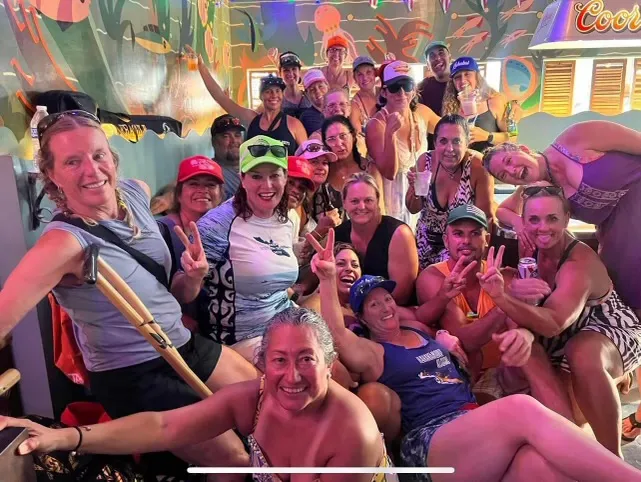
Amid the swells, cross currents and wind chops of the vast ocean, paddlers racing in an outrigger canoe find a transcendent rush in the grueling four-to-six-hour challenge of the Catalina Channel Crossing.
Read more Garden Grove’s Gem Theatre stays alive with musicals, intimate perfomances
The race from Newport Beach to Catalina Island is billed as the U.S. Outrigger Championships, the pinnacle of ocean endurance competition as paddlers engage in a marathon crusade for nothing more than bragging rights and a grand party afterward.
Hosted annually by the Southern California Outrigger Racing Association, the Catalina Channel Crossing Sept. 12-13 will feature more than 70 crews racing in both high-performance lightweight and traditional outrigger canoes from around the world.
There are 15 divisions, including men’s, women’s, co-ed, juniors, senior masters (over 50) and golden masters (over 60). Most crews consist of nine paddlers.
The route is approximately 27 miles from Newport Harbor to Avalon on the first day (women and co-ed) and 30 miles back to Newport on the second day for men.
In the Offshore Canoe Club in Newport Beach, there are varying degrees of experience among paddlers, from novice to expert.
“The Catalina Channel Crossing is my favorite race of the year,” said Mike Ivey, a Newport Beach resident and 10-year Offshore Canoe Club member.
Like most in the Offshore Club, there’s a shared love of the ocean during the euphoric grind.
“It’s all about just working together as a team,” said Ivey, who will compete in the golden masters for the first time. “When all of the paddles enter the water, you’re all pulling at the same time. It sounds easy, but it takes a while to get it down. It’s pure bliss out there.”
The fastest outriggers can reach Avalon in less than four hours, while those in the senior masters and golden masters divisions get there in about six hours.
Read more Prosecutor tells Australian appeals court mushroom poisoning murderer should never be released
“Teams come from all over the world to compete,” Ivey said. “It’s a high level of competition and great camaraderie with a big party after at the Newport Dunes. It’s just a lot of fun, regardless of your ability.
“Everyone’s cheering you on at the finish line,” he added. “Yes, it’s competitive, but there’s so much camaraderie and aloha spirit. That’s what I love most about it. Everybody is super nice and everybody wants to help each other.”
Outrigger canoeing is not for the faint of heart. It requires mental toughness, elite endurance, strong paddling mechanics, teamwork and surf athleticism.
There are changeovers about every 30 minutes, when paddlers jump into the water ahead of the outrigger from a chase boat, while grabbing onto a moving canoe and hoisting themselves up, climbing in fast and balanced and begin paddling immediately in sync. At the same time, other paddlers jump out on the other side. A changeover is completed in about 10 seconds.
During changeovers, a steersman — Ivey’s position for the Offshore Club — must hold a straight line, avoid hitting anyone and keep the canoe stable during the chaos. A bad changeover can tip the canoe, exhaust swimmers or lose valuable seconds.
There is also a famed history of the Catalina Channel Crossing. According to the SCORA website, Newport Beach held the first outrigger race in California on Sept. 20, 1959, from Catalina Island to the Newport Dunes.
Duke Kahanamoku, the famous Hawaiian waterman, served as the grand marshal of the inaugural California Outrigger event and founded the Catalina to Newport Dunes race, originally called the California Outrigger Classic. The subsequent races were underwritten by the Balboa Improvement Association and Ira Dowd, part owner of the Newport Dunes.
While there is no exact founding year for outrigger canoes, historians and archaeologists estimate that their origin dates back 3000-4000 years in Southeast Asia, most likely around the areas of Taiwan, the Philippines and Indonesia.
Richard Dunn, a longtime sportswriter, writes the Dunn Deal column regularly for The Orange County Register’s weekly, The Coastal Current North.
Read more A historic boat emerges in Serbia as Europe’s rivers run dry from drought and heat