
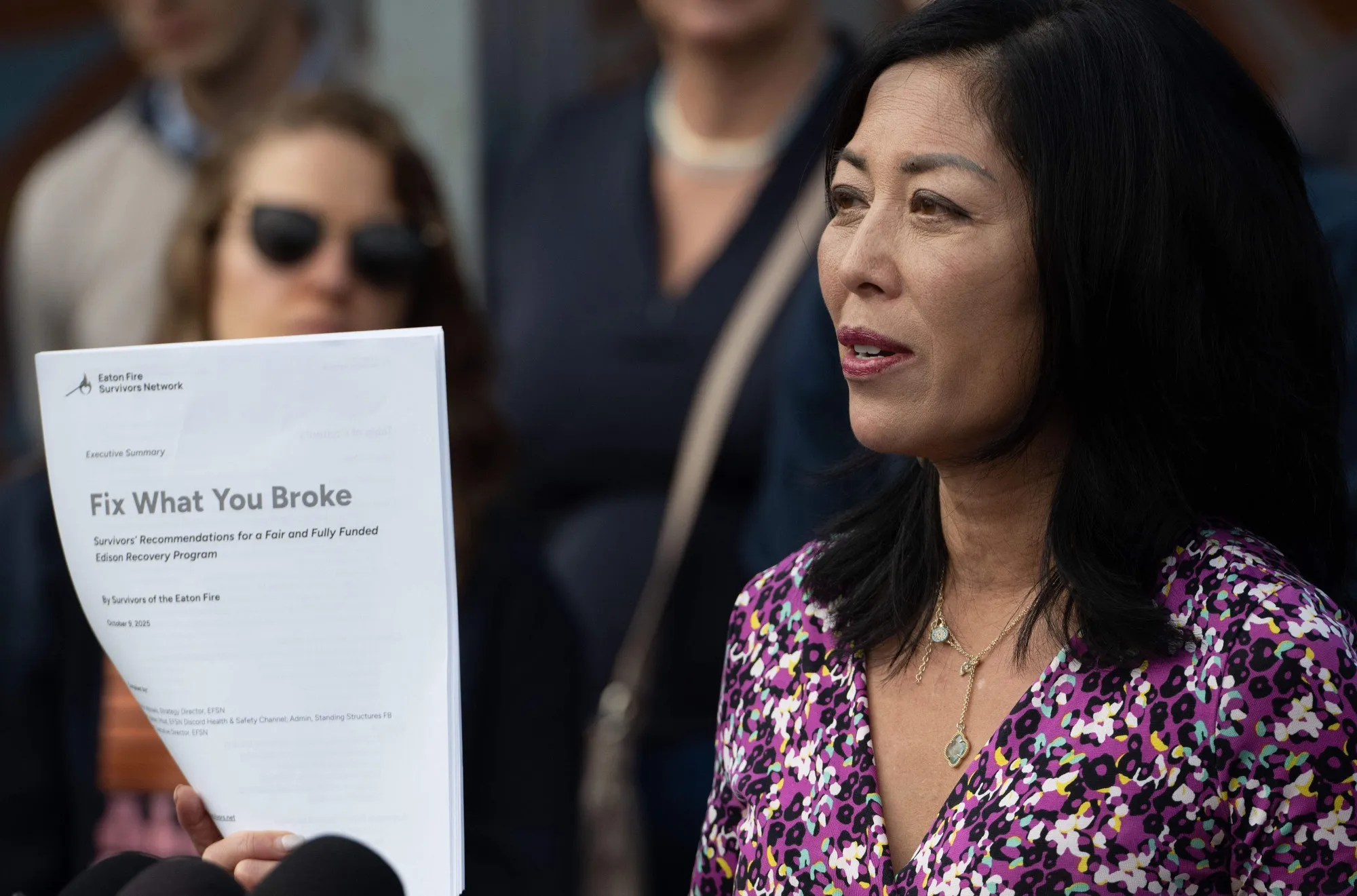
With only about two weeks left before the end of the legislative session, Gov. Gavin Newsom – in his final year in office – has been meeting behind closed doors to try and hammer out a deal with the legislature concerning wildfire liability reforms and payouts to wildfire survivors.
Read more Cal State Fullerton names Shondell Reed as new athletic director
That’s prompted a coalition of wildfire survivors, consumer advocates, insurance companies and attorneys representing survivors to accuse the outgoing governor of wanting to shift some of the liability and costs away from private, investor-owned utility companies – even when they cause the fires. The bottom line, the group says, is that across California, taxpayers and homeowners with insurance policies would end up paying more as a result of this shift.
They characterize Newsom’s proposal as a “bailout” for utilities that they say are already highly profitable and do not need to be thrown a lifeline.
Newsom has yet to release full details of the reforms he’s proposing.
But the governor’s office dismissed the notion of any secret bailout, stating in an email that the Newsom administration had been working on this issue for more than a year, since it became clear that an existing account, the California Wildfire Fund, to compensate wildfire survivors would be depleted following the 2025 Southern California wildfires.
Last year, Newsom signed Senate Bill 254, directing the California Earthquake Authority to study long-term catastrophe financing and resilience options. That study, completed this year, is intended to inform current policy discussions.
“The Administration’s goal is to ensure future fire victims have a reliable source of funds to compensate them for losses,” the governor’s office said in an email on Friday, Aug. 14.
The email went on to say that Newsom’s proposal takes into account “extensive discussions” that have occurred and “packages them into a set of solutions designed to ensure that future fire victims have a reliable path to compensation for their losses, that utility rates remain affordable for all Californians, and that utility executives and shareholders are held accountable.”
The governor’s office also insisted that any changes would not impact payouts for Eaton survivors.
“This does not affect Eaton fire survivors,” the email said. “The reforms apply only to future fires. That has been true from the outset, and it’s a non-negotiable part of the proposal.”
Still, some fire survivors are wary.
Joy Chen is the executive director of Every Fire Survivor’s Network, which was founded by Altadena-area residents after last year’s Eaton and Palisades fires. During a virtual townhall Thursday evening to brief the community on the proposed reforms, she said a state senator involved in the negotiations recently told her there’s an effort to make Newsom’s proposed reforms retroactive so that the rules would apply to the Eaton fire. She declined to identify the senator she spoke with during a follow-up interview.
Newsom’s proposal
According to a “fact sheet” from the governor’s office, there is $22 billion in the California Wildfire Fund to provide payouts to Eaton survivors. But without reforms, that fund will likely dry up and future fire victims seeking compensation may be forced to deal with utilities filing for bankruptcy. In addition, utility companies could continue raising electricity rates with no limit.
The fact sheet also said the proposed reforms promote greater accountability by forcing utility company CEOs to forfeit their bonuses during any year the company is responsible for a wildfire that results in “significant damage” of over $1 billion. The reforms would also tie an executive’s overall pay to safety metrics and impose shareholder penalties of up to $10 million per violation if a company violates safety rules.
The governor’s office said Friday that, contrary to claims made by critics in recent days, the proposal would not limit a fire survivor’s ability to seek economic damages for homes destroyed or damaged in a wildfire, including for smoke damage.
Additionally, Newsom’s office said survivors can still seek non-economic damages, with no ceiling, for their pain and suffering in cases of injury, death or in instances where someone witnessed a family member’s injury. On top of that, anyone who evacuated, or fled the “zone of danger,” can seek up to $150,000 for the emotional distress caused, even if their home did not burn down, the office said.
Critics react to proposal
Critics of Newsom’s proposal have offered a different take about what is in the governor’s proposal.
Chen, who said she met with a representative from Newsom’s office about a week ago, and was briefed on his proposal, said the proposed changes would limit who could seek economic damages to only those whose homes were within a “zone of danger.” Property owners whose homes suffered toxic smoke damage but are located outside that zone wouldn’t qualify, said Chen, calling that scenario “completely crazy.”
Because negotiations are happening behind closed doors, it’s unclear whether the governor had actually discussed this with legislative leaders or whether what Chen described could still end up in the final agreement. Because talks between the governor and legislative leaders are ongoing, nothing is finalized, and details can change.
Chen also called it “completely bonkers” that compensation for the pain and suffering that some survivors experienced would be capped at $150,000. Based on the briefing she said she received, if the new rules end up applying to Eaton survivors, they would be limited to compensation for just the suffering they experienced the night the fire started.
Eaton survivors have lived through more than a year-and-a-half of stress and trauma since Jan. 7, 2025, the day the fire started, yet all the days since wouldn’t be counted in determining non-economic damage payout, Chen said.
A spokesperson for the governor’s office said Friday he would look into whether there is a time limitation for emotional distress claims but had not responded by press time.
In the meantime, other critics of Newsom’s proposal said what the governor is seeking to do would effectively pass some of the costs of wildfires caused by utility companies on to insurance companies.
Jamie Court, president of Consumer Watchdog, an advocacy group, said he’d heard that the proposal would eliminate insurance companies’ right to recoup costs from utilities for home insurance payouts. Should this happen, Court expects insurers to raise the monthly premiums on homeowners’ insurance.
Additionally, Court said he’d heard that the proposed reforms could change how attorneys who represent fire survivors are compensated. The result would mean they would receive less pay, thus making it harder for survivors to find attorneys willing to take them on as clients.
“It’s a total backroom bailout,” Court said of Newsom’s proposal.
“If the governor wants to do that, he’s going to have to suffer the consequences of it for his future political career,” Court added. “Advocates like wildfire survivors and myself will never let him forget it.”
Newsom is considering running for president in 2028.
For Eaton survivors, the idea of bailing out utilities – especially on the heels of a recent L.A. County Fire Department report which identified electrical arcing from an out-of-service Southern California Edison tower as the official cause of the Eaton fire, as fire survivors had long contended – adds insult to injury.
“People have already suffered so much over 18 months,” said Chen, who had to evacuate during the Eaton fire and returned to a home with smoke damage. “For the governor now to be introducing a secret, last-minute bailout, that would cripple survivors, that’s extremely, extremely disappointing.”
Support for reforms
Not everyone opposes what Newsom is attempting to do.
Wildfire Victims First, a coalition the group says is made up of more than 275 organizations ranging from chambers of commerce and business associations to labor unions, nonprofits and housing advocates – and which includes California’s three biggest investor-owned utilities: Southern California Edison, Pacific Gas & Electric and San Diego Gas & Electric – have come out in support of many of the recommendations that came out of the California Earthquake Authority’s study earlier this year to address long-term catastrophe financing and resilience.
Nathan Click, spokesperson for Wildfire Victims First, said in a statement that the earthquake authority’s report highlighted how under the state’s current payout system, “financial middlemen – like trial attorneys, hedge funds, and insurance companies – are often paid out before wildfire victims receive a single dollar for rebuilding.”
The group, Click said, supports reforms that would reduce wildfire risk and strengthen prevention; increase access to affordable, comprehensive insurance; and “ensure victims are compensated fast, fair, and first — not after years of litigation or after being preyed on by hedge funds.”
“Following the Earthquake Authority report, we have called on state legislators to urgently implement many of its conclusions and our calls continue to this day,” said Click, who has previously served as a spokesperson for Newsom.
Time is running out for Newsom and the legislature to reach an agreement, as the final day of this legislative session, Aug. 31, approaches.
Meanwhile, Chen, Court and others are demanding that any bill laying out the reforms be made available immediately, rather than at the very last minute, so the public has time to vet the legislation. They say the governor hasn’t been transparent enough about his plans.
“If this was something that would be good for California, why wouldn’t he (Newsom) just announce it publicly?” Chen asked. “And why wouldn’t he release the bill language?”