
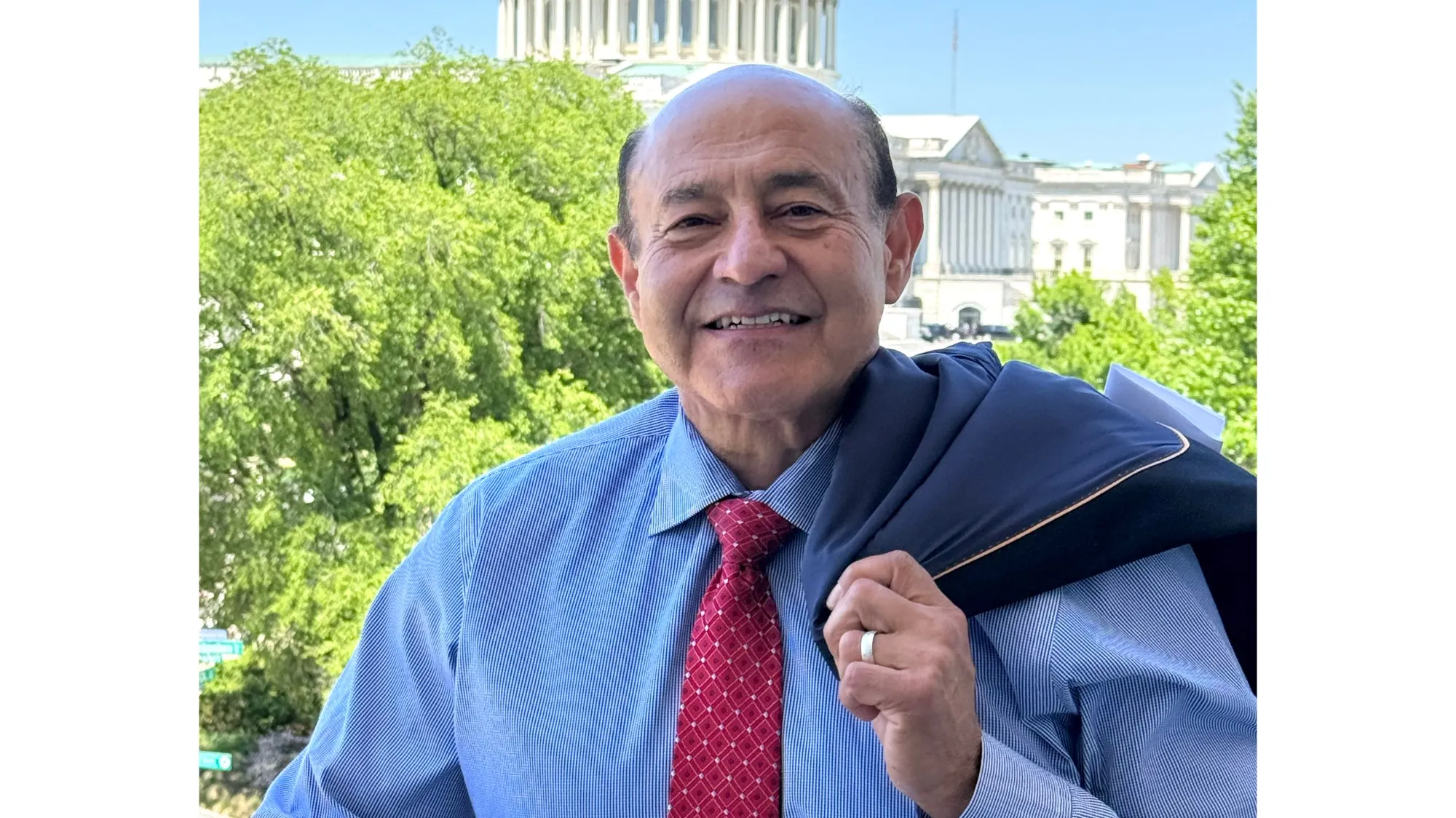
Ahead of the November general election, the Southern California News Group compiled a list of questions to pose to the candidates who wish to represent you. You can find the full questionnaire below.
Read more David Pan, CA-46 candidate, 2026 election questionnaire
Name: Lou Correa
Age: 68
Current job title: U.S. Congressmember
Political party affiliation: Democratic
Incumbent: Yes
Other political positions held: California State Assembly, Orange County Board of Supervisors, California State Senate
City where you reside: Santa Ana
Campaign website or social media: loucorrea.com
What is the single most important issue this district faces, and what can Congress, realistically, do to address it? (Please answer in 200 words or less.)
Immigration.
President Trump promised to deport “the worst of the worst. Today, most of the individuals he is deporting are hard-working taxpayers who have lived in our communities for decades and are part of our workforce. Many deported have work permits, like Dreamers. Others are refugees whose protective status is being terminated. And shockingly, some who are being deported are spouses and immediate family members of American soldiers on active duty. These are not criminals and certainly not the worst of the worst.
Immigration is about our economy. California today is the fourth-largest economy in the world. We lead the nation in agriculture and food production, as well as light manufacturing, biomedical, high tech, and high-tech startups, and venture capital. All these industries rely on an immigrant workforce.
The U.S. Chamber of Commerce’s primary goal is 3% annual economic growth. Their second is immigration reform. Our economy needs immigrant workers to grow, these workers that are being deported.
President Ronald Reagan would say, “”I’ve spoken of the shining city all my political life… And if there had to be city walls, the walls had doors, and the doors were open to anyone with the will and the heart to get here…”
Housing is increasingly unaffordable and remains top of mind for many Californians. What is one federal policy you’d push to make housing more affordable? How would you measure whether that policy was actually successful? (Please answer in 200 words or less.)
Over the last few decades, we have not built the housing to keep up with our needs. This is especially true for first-time home buyers. As a result, the American Dream of homeownership is no longer viable. This is unacceptable.
The solutions require taking action at every level of government, federal, state and local, and a healthy private housing construction sector to deliver homes to homebuyers.
At the federal level, we passed the “21st Century ROAD to Housing Bill (Public Law 119-101, July 2026),” the first bipartisan legislation in decades addressing housing supply shortage. It’s one of the most significant federal overhauls of housing supply and lending regulations in decades.
Yet, local control is the bigger factor in housing availability. Local city councils decide what to build and how much. They must be incentivized to build housing and support first-time homebuyers. We must all support the American Dream for the next generation.
Looking ahead in Congress, we must ensure that financing is available and affordable. We must continue to oppose President Trump’s efforts to dismantle our critical housing programs. Let’s keep 30-year mortgages available. Let’s keep government programs viable for first-time homebuyers, like veterans, teachers, police officers, as well as others.
Concerns about the use of surveillance technology have intensified recently, often relating to license plate readers made by Flock Safety. How can Congress balance the use of these technologies in public safety cases while limiting infringement on an individual’s right to privacy? (Please answer in 200 words or less.)
Whether we speak of “FISA 702,” the spy program, or Homeland Security’s new spying tools, or Flock cameras, there is an urgent need to protect our privacy, our identity, and our personal data — that both public and private entities look to collect, share, and sell — without our knowledge and without our consent.
We need to have the legal right to opt out of the sharing of our information with private and government entities. We need to know when our personal data is being sold. And we must have the ability to stop the selling of our personal information. And if entities use our personal data to make a profit, people should have the right to demand payment for the use of their data.
Congress needs to pass laws that make it clear that you can’t collect our data without our explicit authorization, and that you can’t share our data with private or government entities without our express consent. And, if government has legitimate reason to “spy” on Americans, it must be done with a judicial warrant.
What should immigration policy in the U.S. look like five years from now? (Please answer in 200 words or less.)
Immigration reform has eluded policymakers for decades. The last true immigration reform was under President Ronald Regan.
I would like to see the “Registry Bill (H.R. 4696 – 119th Congress)” advance. Current law states that anyone in the country before 1972 may apply for adjustment of status, given that the individual is of good moral character and meets other requirements. The Registry Bill simply changes the date from 1972 to seven years before the application date. The date has been changed a number of times since its inception. Let’s change the date again to 2019.
Would you like to see any changes to Medicare, Medicaid or prescription drug policies? What specifically would you change, cut or fund? (Please answer in 200 words or less.)
President Trump got elected promising to eliminate the Affordable Care Act and replace it with something better. Well, he gutted the ACA and has instead reduced the amount we invest in healthcare for Americans. The result has been more uninsured Americans and less healthcare for Americans. We are again turning to emergency rooms for our healthcare.
We do need to implement changes to Medicare Medicaid, as well as other programs in this country. It starts with reversing the cuts made by HR1.
We must always be vigilant in addressing fraud, waste and abuse. Too many fraudulent bills. We must be more efficient in delivering healthcare services, better coordinated medical data, and more preventive care.
We need to ensure that we have a cost-effective, healthy nation.
Increasingly, we’re seeing communities push back on data centers opening in or near their neighborhoods. Environmentalists complain about the amount of water and energy that data centers need to operate. Residents complain about relentless noise pollution. And others worry about losing agricultural land to these centers. On the other hand, the tech industry emphasizes the role of data centers in supporting cloud computing and artificial intelligence. As a policymaker, how would you balance the concerns of critics with desires to ensure that the U.S. remains a leader in innovation? (Please answer in 200 words or less.)
AI promises to change our lives, in many ways. AI is helping develop cures for cancers as well as other miracle drugs. Data centers and AI must be about making life better for all. The AI race should not be “to win at all costs,” as many propose. Rather, let informed voters decide.
Will there be job losses? Yes, and how will we address those whose jobs are lost?
Will data centers result in polluted water? We must have assurance that our precious drinking water is not further contaminated.
Read more Jenny Rae Le Roux, CA-47 candidate, 2026 election questionnaire
Will data centers lead to higher electric bills? Electricity is already too expensive. Let’s make sure there is no cross-subsidization by the average rate payers.
As local, state and federal governments engage in policy decisions about data centers, let’s ensure full public disclosure and no “backroom deals,” and prohibit the use of “non-disclosure agreements” by governments or their agencies. Taxpayers and ratepayers deserve to be part of the decision-making. It’s more about the will of the people than it is about balancing different interests.
There is growing debate about whether political candidates or committees should be allowed to run ads created with the use of artificial intelligence. Recently, we’ve seen videos or images depicting a candidate’s political opponent in disparaging ways – and which some critics say falsely misrepresent their political rival. In your opinion, should there be a strict ban on AI-generated political content? If AI-generated content is permitted, should there be restrictions on its use? What should the terms be, if any? Explain your position. (Please answer in 200 words or less.)
AI or not, misleading and disparaging ads have always been part of our political landscape. And the U.S. Supreme Court has usually sided on side of “free speech,” in looking at limiting what someone can say in a campaign and on campaign spending limits. Political campaigns are notoriously full of misinformation.
The challenge with AI is that it can be not just spin, but outright lies, presented in ways that make it hard for the average voter to discern truth from outright lies.
There should be severe consequences for those engaged in outright lies, possibly creating public and private causes of action to ensure that if candidates know of outright lies and deceptions, that such will not be tolerated, and that a severe price will be paid for such. And, there should be a disclosure that lets the voters know that AI was used in a campaign.
Throughout my career, I have seen many brazen efforts to suppress voter turnout, to intimidate voters from voting. And misinformation is a weapon that suppresses voters. Yet we know the First Amendment is very protective of free speech. We must be vigilant against voter suppression efforts.
How should the U.S. balance support for foreign allies with concerns about the country’s spending and the risk of entering “forever wars”? (Please answer in 200 words or less.)
First, let us again restore Congress’ central role in declaring wars. Short of a response to an attack or immediate threat to our nation, Congress needs to be directly involved in such decisions. And, after any and all military action, Congress must be briefed immediately, and Congress must vote to continue or not continue such military action.
And, when it comes to our commitment to mutual defense pacts, such as NATO, Congress must have a direct role and not cede our power to executive orders.
We do currently have such a legal framework. Sadly, the administration has decided to bypass Congress and engage us in military conflicts. Currently, there are no checks on the executive branch.
We are getting into another “forever war” in the Middle East, one that Congress had no say in.
Helping our allies and protecting our national interests are decisions that are to be based on the best interests of our nation. As such, Congress needs to affirmatively vote on such.
The Trump administration is aggressively pushing to expand offshore oil drilling and production in California. Do you support this move? Why or why not? (Please answer in 200 words or less.)
Our nation needs to be energy independent. And we need a smart, balanced, long-term energy policy that harnesses all energy options as we transition to renewables. That means that we have to make sure people can afford to fill their gas tanks today. That means we continue to harness solar energy, wind energy, geothermal and continue to invest in energy R&D.
In addition to national energy independence, our nation must also be able to feed our population and recognize that we will increase our reliance on the oceans to feed our nation. And we must be sure that the food we eat, including seafood, is not contaminated. Accordingly, we must protect our future food supply, and that includes our oceans. The threat of offshore oil spills and the threat to our future food supply make offshore drilling unwise. I have vigorously opposed efforts by the Trump administration to expand offshore drilling and have cosponsored legislation to permanently ban offshore drilling off the coast of California.
The polarization of politics in this country has only grown. If you’re the incumbent of this office, what’s an example of you bucking that trend and cooperating with colleagues you may have political or ideological differences with? And if you’re running to step into this office for the first time, what’s an issue you will work on with those across the aisle to tackle? (Please answer in 200 words or less.)
I’ve always worked with my colleagues across the aisle. Today in Congress, most of my successful legislation has been co-authored with Republicans. From helping veterans with PTSD using new medicines such as psychedelics, to reforming the bankruptcy code, to the 21st Century ROAD to Housing Bill. These efforts have all included working across the aisle.
This work starts with building relationships that lead to trust. We may not agree on everything, but by talking, we find areas of common interest that lead us to legislative solutions to national problems.
This is “not bucking the trend.” It’s called working together to solve problems faced by all taxpayers on Main Street. I was sent to Washington to represent all of my constituents, not just Democrats, but all constituents.
Tell us about a time you’ve changed your mind on a political position. What was it, and what changed your mind? (Please answer in 200 words or less.)
Actually, it’s not changing my mind but learning my lesson: to “trust and verify” the executive branch.
Our Founding Fathers set up our Constitution to be one of those checks and balances, with the legislative branch with “power of the purse,” and power over tariffs. Over the last few decades, most Democrats and Republicans have ceded our legislative constitutional powers to the executive branch. Today, we have a president engaged in many wars, both economic and military, without the approval of Congress.
Most of this transfer of power is because of Congress’ inability to work together. Our nation’s deep political divisions result in a paralysis because members are reluctant to work across the aisle. This is not good for our nation.
Bonus question: What is the best book you’ve read this year? Explain why you found it compelling.
My job relies on good information and determining how such information affects my voting decisions and my constituents. Sorting through this data — and determining which data to use — is the task my staff and I undertake on a daily basis. I don’t read many books, but I read many reports and many, many newspapers, from the OC Register to the NY Times to the WSJ.
Read more Dave Min, CA-47 candidate, 2026 election questionnaire