
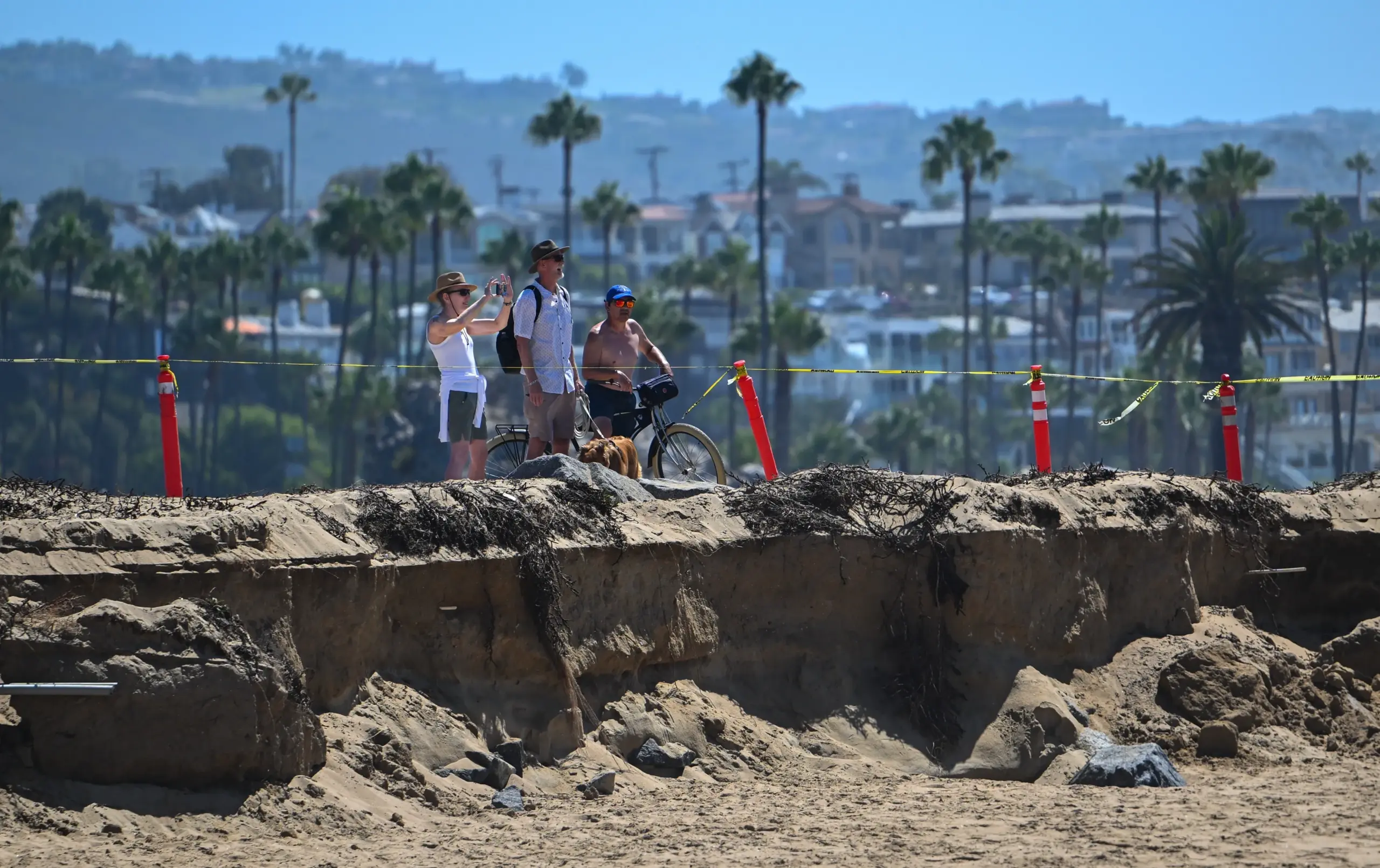
Newport Beach will be allowed to pull an estimated 200,000 cubic yards of sand from the Santa Ana River as part of an emergency permit to address its eroding shoreline, as a series of relentless swells batters the coast.
Read more FAA begins rollout of AI air traffic tool to reduce delays
Sections of the Newport Beach coast, along with several others across Southern California, have been hammered by several back-to-back tropical storms this summer that have devastated coastlines, pulling away sand and leaving homes and infrastructure at risk.
The emergency agreement between OC Public Works and the city of Newport Beach to help expedite permitting to move the 200,000 cubic yards of sand from the Santa Ana River outlet to the city’s eroding shoreline was announced Friday.
“This move comes at a critical time as coastal cities reckon with the damage caused by Hurricane Marie and prepare for this winter’s El Niño storm season,” Fifth District County Supervisor Katrina Foley said in a statement.
Governments must act quickly and cut through unnecessary red tape to protect shorelines and critical coastal infrastructure as a forecasted super El Niño storm season nears, Foley said.
“In Orange County, sand is infrastructure,” she said. “Along the entire Orange County coast, we must accelerate sand replenishment and shoreline protection to protect our homes, beaches and infrastructure.”
Newport Beach Deputy Public Works Director and City Engineer Jim Houlihan said the sand will be put between the groin jetties in West Newport, an area that has an existing permit and systems in place to receive sand.
Taking the sand to the Wedge or Balboa Peninsula, areas that also suffered significant erosion in recent months, would face transportation and permit challenges, Houlihan noted.
There are talks, however, to potentially dredge sand from the Newport Harbor entrance and have it pumped over the rock jetty onto the Wedge, he added.
The city has also submitted several storm-related infrastructure projects in hopes of recouping costs under the county’s declared state of emergency. Cost to shore up sand into berms at the Balboa Pier, for example, cost an estimated $100,000.
Houlihan estimates crews will probably only get about 100,000 cubic yards out of the Santa Ana River, using the county’s already-established permit. It’s a project that typically happens each year, and last occurred in January, but the city wants to get ahead of the El Niño storms to add a buffer on the beach.
The city will put out a bid for a contractor in the coming days, with the sediment to fill in the groin jetties between 40th and 60th streets available by the end of October.
Read more Social Security is phasing out paper checks this year. Here’s what beneficiaries need to know
That cost is expected to be about $1 million to $1.5 million.
In the Wedge area, the hydraulic dredging project would cost an estimated $4 million to $5 million and could take up to 18 months, Houlihan said.
“Those are the three areas we are trying to get to as quickly as we can,” he said.
Sean Starky, who has been watching the sand erode at the Wedge for the past decade, argues sand nourishment needs to be viewed as infrastructure, in the same way harbor dredging or paving roads receives regular maintenance.
“It’s not just a city issue, it’s county and state,” he said. “It’s going to be interesting next week, because there’s another big hurricane.”
Starky, a bodysurfer who owns the brand Yucca Fins, said the erosion has been especially bad this year — it’s because of the direction of the hurricane swells, with a slight easterly direction that comes in at an angle that has caused severe erosion.
Some sand may return in the winter with the west swells, officials have said, but there’s “obviously not enough,” said Starky.
“We’ve lost, since 2023, 150 feet of beach,” he said, noting that once sand is pulled offshore, some ends up in a deep, underwater canyon.
Long Beach resident Marc Moore is also concerned about a stretch in Long Beach, where a seawall along the peninsula has no protective beach in front of it.
A surf forecast is showing 8- to 12-foot waves and a 6.4-foot tide next Tuesday, Sept. 29.
“My concern is that Long Beach’s Peninsula beach and seawall are in far worse shape today,” Moore said, noting that a community meeting with the city isn’t happening until Monday.
Read more With the world’s leaders waiting, Trump meets with Mamdani