
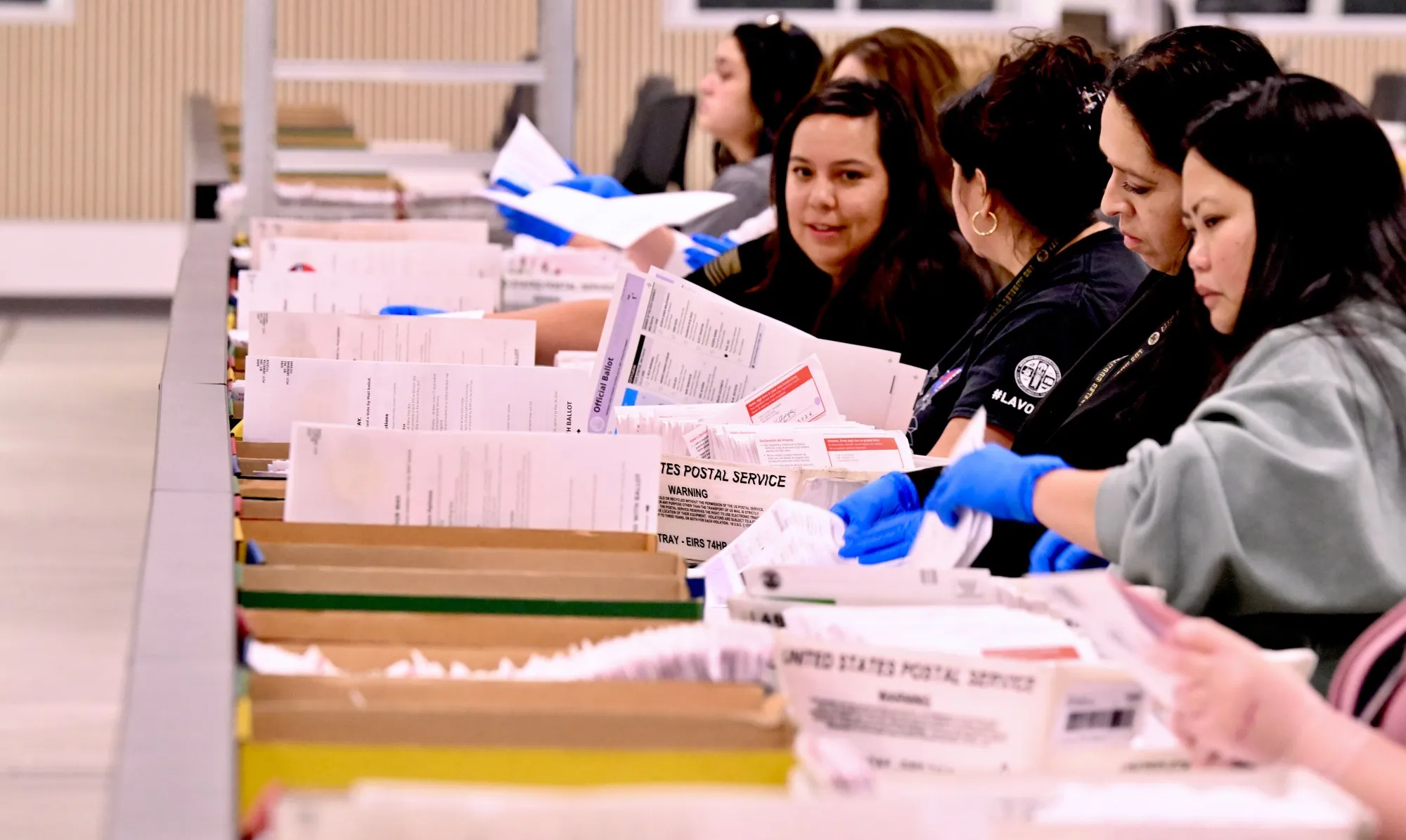
The short answer to whether the U.S. Supreme Court’s decision allowing the Trump administration to continue its plans to restrict mail voting immediately impacts California elections is no.
Read more 49ers owner Jed York used fake name to text fictitious sex worker before arrest
But that also doesn’t mean California’s voting system — which relies heavily on a mailed ballot system — is completely safe from the president’s attempts to overhaul how states conduct elections ahead of November, experts say.
Depending on who you ask, California may be subject, just in time for the midterm elections, to the U.S. Postal Service’s new rule requiring states to submit lists of the voters who are eligible to receive a ballot in the mail and to place unique barcodes on the ballot envelopes.
A former Biden administration official believes the legal battle will continue well past the time when the new rule could be realistically implemented.
But a former Trump-appointed elections official exudes confidence that the Supreme Court has cleared the way for changes to be made just under the wire.
All that to say: With about a month to go until California is scheduled to mail ballots to every registered voter in the state, there is still a bit of uncertainty enveloping this election season.
What the Supreme Court did is “procedural just for this business day, but in substance, it did not clear up the confusion that we can see on the horizon,” said Matt Lesenyie, an expert in political psychology and California politics who teaches at Cal State Long Beach.
‘Red light, green light’
First things first: It’s important to understand that the Supreme Court did not rule on the legality of President Donald Trump’s executive order restricting mail voting.
It instead said the group of Democratic-led states seeking to block the order — led by California — did not have the appropriate standing. Essentially, the court said because the Postal Service had not formally implemented a rule regarding mail ballots when the states brought the lawsuit, it was simply too early to consider whether the states had suffered harm.
“Lawyers and people who teach procedure will have real strong feels about the merits on the issue. But what does it practically mean for California voters? The answer is practically nothing,” said Justin Levitt, a constitutional and elections law expert who teaches at Loyola Law School.
Levitt envisions what happens next to be a bit like that “red light, green light” playground game.
The Supreme Court allowed, in part, Trump’s executive order to move forward because of a technicality. (It’s in part because there is another order blocking it in a separate case. Experts expect this one to suffer the same fate soon, though.)
Green light.
But the Postal Service has that would prohibit it from sending ballots from states that do not comply with Trump’s order and would require an overhaul of the envelopes containing ballots.
With a rule in place, states can again sue — and California Gov. Gavin Newsom was quick on Monday to promise to do just that.
NEW: Following today’s SCOTUS ruling, California WILL SUE again to BLOCK Trump’s attack on mail-in voting!
Every eligible voter gets a mail-in ballot here — and we’ll fight to keep it that way.
— Gavin Newsom (@GavinNewsom) August 25, 2026
Lower court judges could again side with the states, blocking the executive order.
Red light.
“I think that ends up with Californians voting exactly as they anticipated voting” in the midterms, said Levitt, who served the Biden administration as the White House’s first senior policy advisor for democracy and voting rights, working to “ensure that every eligible American has secure, reliable access to a meaningful vote,” among other things, according to his bio.
“In practice, I don’t think this rule will affect California one bit,” he said.
But Trey Trainor, a Republican and former chair of the Federal Election Commission, doesn’t anticipate such a fitful path for Trump’s executive order, which he supports.
The Supreme Court set a standard this week by saying the states could not yet show any harm — and that’s not going to change anytime soon, Trainor said.
Read more Angel City FC’s Angelina Anderson blooming with confidence
Besides, he argued, the Postal Service’s rule is a simple one, with minimal impacts.
“The state can take the current voter role and give it to the Postal Service, and the Postal Service isn’t doing any checks, just making sure they’re sending ballots to the people who asked for ballots,” said Trainor, a partner at the Dhillon Law Group, founded in San Francisco by Harmeet K. Dhillon, a conservative lawyer who has led the U.S. Department of Justice’s Civil Rights Division since 2025.
He called Trump’s executive order “common-sense steps.”
“They make elections more secure, and that’s good for every voter who plays by the rules,” said Trainor.
Not so simple
Some counties — Los Angeles and Orange, for example — already print unique barcodes on ballot envelopes, albeit whether these would be accepted as is, without changes, under the executive order may be up to interpretation.
Registrar of Voters Bob Page, though, noted Orange County’s barcoded ballot envelopes have already gotten the stamp of approval from the Postal Service.
“We have gone through the process, knowing the direction that was in the executive order and having seen an earlier draft of the Postal Service rule, we took heart to make sure that the Postal Service had approved the envelopes that we’re using for this election,” Page said, adding, “I can’t predict if the Postal Service will do something else, but they’ve already approved the envelopes that we have at the printer.”
The envelopes for the general election cost $350,000 to print, Page said.
Ballots will begin being printed for overseas and military voters by the end of next week, with the rest scheduled for the week of Labor Day, Page said. Federal law dictates Sept. 19 — 45 days before Election Day — is the deadline to send ballots and other voting materials to military and overseas voters who have requested them.
“The thing about the executive order and the Postal Service rule that, I think, will be something we can’t predict what the result will be is the requirement for people to share information back and forth regarding registered voters. That’s something that I expect litigation will have to resolve,” Page said.
And L.A. County’s election office said any changes at this stage would be “significant given the fast-approaching timeline for mail ballots.”
“The ongoing efforts to modify the electoral process amid an election cycle are deeply troubling and frustrating,” said Dean Logan, who oversees L.A. County’s elections.
Riverside County’s registrar of voters is prepared to follow any guidance coming from the secretary of state’s office, said spokesperson Elizabeth Florer, who noted its workers “are experienced in adjusting to legal and procedural changes.”
Logan, meanwhile, said his L.A. County office will continue to push voter outreach and education efforts, especially as active litigation regarding the Trump administration’s guidance is ongoing.
“One of the most significant risks we face is the possibility of voter confusion and diminished participation — outcomes that run counter to the principles of free and fair elections,” said Logan, the registrar-recorder/county clerk.
That’s similar to the message coming from California Secretary of State Shirley Weber, who said the Supreme Court is allowing Trump to “sow distrust in state elections.” California, she said, will continue to fight the executive order.
“Rest assured, California’s elections officials will continue to do everything within our power to ensure that every eligible California voter has the right to cast a mail ballot and have that vote count,” said Weber, who is running for reelection this year.
Some Democratic lawmakers have been a bit sharper in their response to the nation’s highest court.
“The court is actively aiding and abetting Trump’s efforts to steal this election, and we must stand up and call it out,” said Rep. Dave Min, D-Irvine.
“Let’s be clear: Donald Trump is a loser who can’t handle the fact that he was defeated in the 2020 election,” said Rep. Robert Garcia, D-Long Beach. “He’s attacking vote by mail because he’s afraid of losing the midterms, and because he wants to push conspiracy theories and bogus claims.”
Staff writer Allyson Vergara and The Associated Press contributed to this report.
Read more Chargers end camp with some positions still up for grabs