
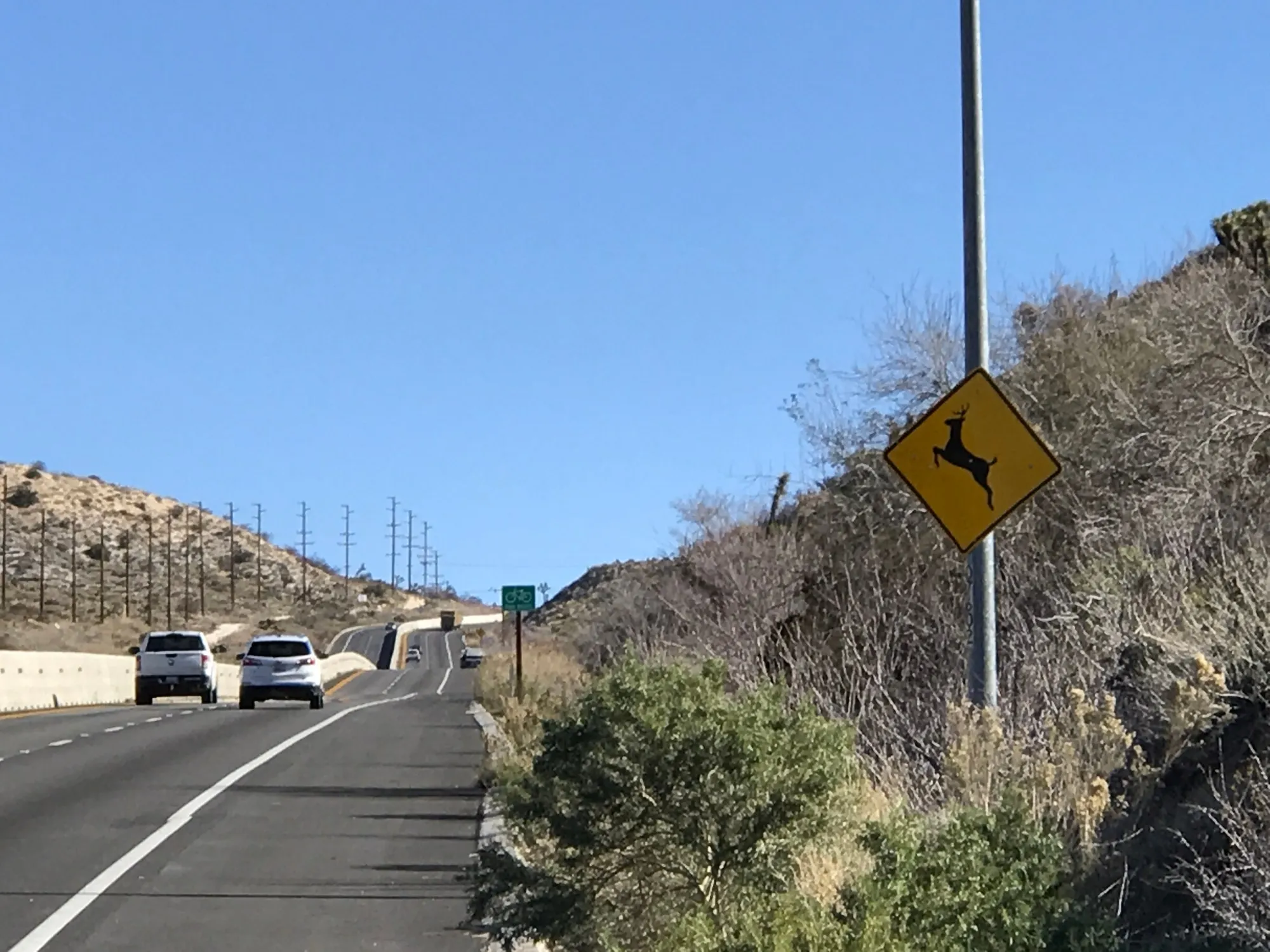
Wildlife researchers have begun surveying areas along State Route 62 to collect data on bighorn sheep to guide in the planning and design of two wildlife crossings near Joshua Tree National Park.
Read more Residents near Maui wildfires show elevated metals linked to impacted lung health, study says
The work is part of a larger study of wildlife activity — movement and genetic exchange among bighorn sheep, mountain lions and bobcats — across the highway at the Morongo and Yucca grades, between Morongo Valley and Yucca Valley. Researchers will collect animal droppings for DNA analysis, according to the Mojave Desert Land Trust.
On Oct. 6, specially trained detection dogs and their handlers will join the survey, scouting for droppings, or scat. DNA analysis of the samples will help researchers identify individual animals and better understand movement and genetic exchange — mating between populations — across the highway, while establishing a baseline to compare wildlife activity before and after the crossings are built, the land trust says.
The first phase of the study that began Friday, Sept. 25, runs through April 2027 and is funded by the Mojave Desert Land Trust through Caltrans mitigation funds, said Geary Hund, senior biologist and wildlife crossing project manager.
The study, Hund said, will take place in phases, before and after the wildlife crossings are built. The first phase will include a genetic assessment of how divided wildlife populations are, providing a baseline for future comparison.
“Generally, these genetic studies are long-term studies that can be informative for years to come and be used to track changes in genetic health as the crossings are adopted by wildlife,” Hund said.
A second phase, if funded, would run through December 2029 and include roadkill surveys beginning in spring 2027. A third phase would follow construction, Hund said.
Researchers have sufficient data to support the general locations of the crossings, but are studying specific alignments within those areas, Hund said. New research could lead to minor alignment adjustments if it reveals new information about wildlife movement.
The two planned wildlife crossings are intended to restore habitat connectivity between the San Bernardino Mountains and Little San Bernardino Mountains, preserving an ecological corridor linking the Mojave Desert, Coachella Valley and nearby protected lands, including the Sand to Snow National Monument.
A major goal of the crossings is to reduce wildlife carnage on the highways. From October 2019 to November 2020, there were 232 fatal wildlife-vehicle collisions on State Route 62, including mountain lions, black bears, bighorn sheep and mule deer, according to the 2021 Morongo Pass Wildlife Connectivity Study commissioned by Caltrans.
Read more What is a Kelvin wave, what does it have to do with El Niño, and should we be worried?
The Mojave Desert Land Trust, Wildlands Network and Rogue Detection Teams are partnering on the research.
The Mojave Desert Land Trust has secured more than $6 million in state grants to plan and design the crossings, including a $5.5 million grant from the California Wildlife Conservation Board in February and a $512,000 grant from the Coachella Valley Mountain Conservancy in May.
The funding came a month after an 18-month-old mountain lion was struck and killed on SR-62.
No firm timeline has been established, but officials estimate it could take seven or eight years before both crossings are completed. Construction funding is still being pursued.
The need for wildlife crossings has become increasingly apparent across Southern California, where an extensive network of freeways and highways cuts through mountain ranges and other wildlife habitat while continued development has left animals with smaller, more isolated areas in which to live.
The region has become a focal point for planned and proposed wildlife crossings, including projects in the Santa Monica Mountains, the Mojave Desert and Inland Southern California.
In Agoura Hills, the $114 million Wallis Annenberg Wildlife Crossing is set to open in December, and will be the largest one of its kind in North America.
In San Bernardino County, Caltrans has partnered with federal agencies and Brightline West, which is is building a 218-mile, all-electric high-speed passenger rail line between Las Vegas and Rancho Cucamonga, to construct three wildlife crossings on Interstate 15 between Barstow and the Nevada state line.
In Temecula, a $4 million wildlife crossing is planned over Interstate 15 at Rainbow Canyon, between the Palomar and Santa Ana mountains. The crossing, south of State Route 79, remains in the planning and environmental review phase, with final design not yet completed, according to Caltrans.
Read more Questions linger as GKN Aerospace plans to resume phased operations