
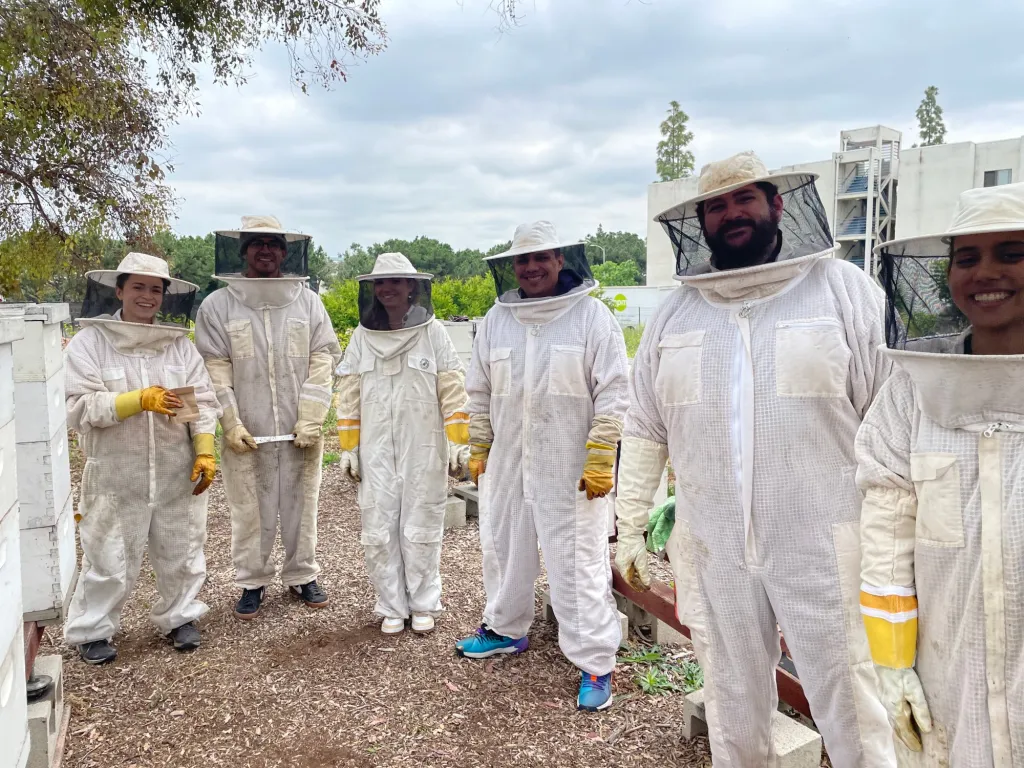
Within the grounds of Cal State Fullerton’s blooming 26-acre Arboretum and Botanical Garden, an apiary with multiple bee colonies serves a valuable dual purpose. It’s a source of research for students across many disciplines who study aspects of honey bee behavior and the challenges to their survival. And it’s a source of honey that the Arboretum uses to raise money and the Monkey Business Café in Fullerton uses in many of their foods.
Read more More than half of Latin Americans deported from US to Congo are now back home
The apiary was established in the 1970s, but it wasn’t until 2017 that Cal State Fullerton anthropology professor Sara Johnson developed it for student learning. She’s involved in the Urban Agriculture Community-based Research Experience or U-ACRE, a partnership of Southern California organizations with a shared goal of involving students in community-based research projects in “everything related to agriculture and community, food security and nutritional sufficiency,” Johnson said.
A colony is the social group of bees, Johnson explained, and the hive is the box they live in.
“In the beginning we had six hives with six nuclear colonies. As they started to reproduce, we added a second grid box, and later we started harvesting honey.”
As a satellite hub of the UC Davis California Master Beekeeper program, Johnson’s work with the apiary supports undergraduate and graduate student research involving honey bees, their pollen-gathering activities and the threats to their survival.
“The biggest challenge is varroa mite, which has the genus species name of Varroa destructor,” Johnson said. “It’s one of the most serious threats to honey bees worldwide.” Though they are tiny, these parasites feed on the honey bees’ developing larvae.
Students trap varroa mites and bring them into the lab to examine them under a large microscope. They study the life stages of the mites and identify types that show a high potential of reproducing at any given time, which indicates the threat to the bees is about to increase. The honey bees actively work to kill the mites, but this can take them away from other productive behavior.
Climate change is an additional threat because warmer, drier weather enables varroa mites to remain active longer.
“Students get so excited about the fact that they’re able to learn things and then implement a strategy to help reduce the varroa mite based on what they’ve learned,” Johnson said. “They’re excited about what they can do to contribute to solutions.”
Read more Former supermodel Carré Otis files Paris rape complaint against ex-Elite boss
Research at the apiary is open to all majors, including anthropology, environmental studies, chemistry, biology, mechanical engineering and even computer science. Students have made videos of bees and used behavioral observation software in their research, Johnson said.
Students also use the apiary for group projects across disciplines. “You need people from different disciplines who are able to work together,” to fight the challenges of honey bee survival, Johnson said. “Our students learn how to work on an interdisciplinary team, how to build on the information that other people are giving you outside of your discipline, and to use your discipline to its full advantage to solve a problem.”
Funding from the National Institute of Food and Agriculture provides stipends for student research, as well as some of their tuition and book fees, Johnson said. Service learning students from CSUF colleges and departments use the apiary as a complement to their classroom studies.
Half the honey produced by the apiary goes to the Arboretum to sell and the other half goes to Monkey Business Café, a social enterprise restaurant in Fullerton designed to provide workforce training for young adults transitioning out of foster care.
Other partners of the program include Bill Gibson at Orange County Beekeeping Supplies, who shares his knowledge with students. “We’re really open with each other on what we’re doing and what we’ve learned,” Johnson said. “And it’s very helpful when students want to know if something they’ve developed could be used by beekeepers.”
Exchanging knowledge with local professionals is invaluable. “This is where that community engagement comes into play,” Johnson explained. “These people, this is their livelihood, and they’re telling us this would work, or this wouldn’t. Or this is a challenge I have that you haven’t thought of yet, and this is the challenge we need to meet.”
Future employment for students can include working in chemistry labs that study the effect of pesticides on bees or working in a government agency such as the U.S. Department of Agriculture, Johnson said.
“The USDA is a big one because honey bee colony collapse is a major issue facing all of us,” she said. “And the USDA has active research. They want students who come with a skill set and with the passion and resilience to be able to take on huge challenges. At CSUF, we give students the skill sets to be able to step from being a student to being an active participant in research at a higher level.”
Read more Anthropic urges a way to pause AI development as risks grow with the tech advances