
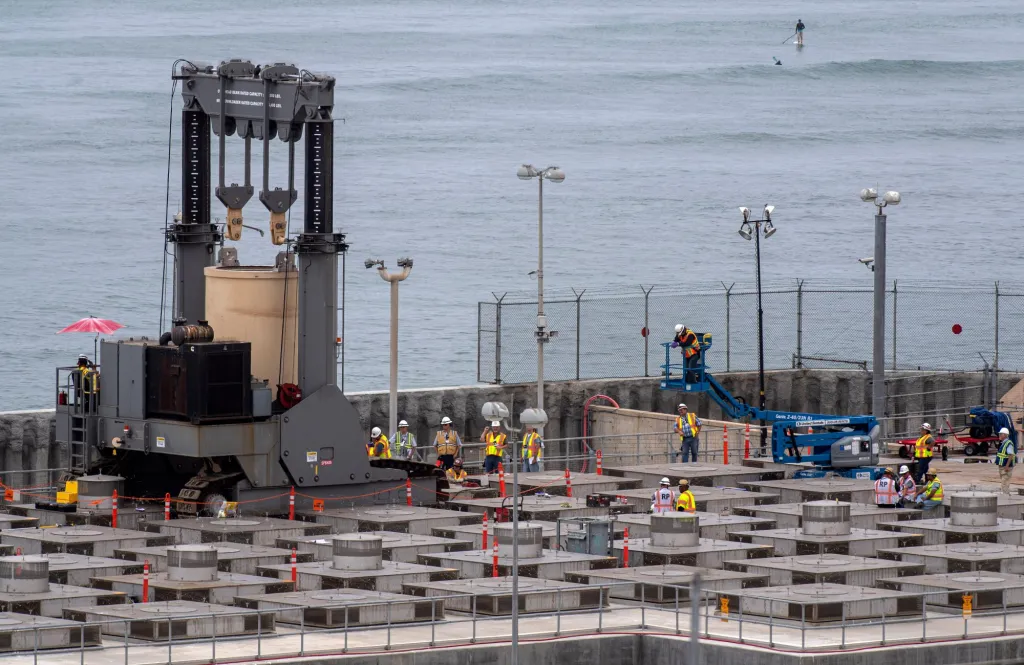
How will we know if a steel canister filled with highly radioactive nuclear waste is starting to crack?
Read more Opening of Canada-US bridge that Trump threatened to block is delayed over unresolved ‘issues’
This is an oft-expressed worry of people living near the San Onofre Nuclear Generating Station, where more than 100 waste storage canisters sit encased in concrete, just feet from the salty Pacific, awaiting a permanent home. The canisters were designed to last 100 years, but are licensed for 20. Most everyone agrees that an earthquake zone near 8 million people is not the ideal place to park them for decades on end.
While the nation agonizes over where to put this waste permanently, San Onofre is slated to test new technology that promises constant monitoring of every cask, every day.
That’s not quite how things work right now.
Currently, Southern California Edison’s aging management tools are designed to catch problems before they start by deploying robots and cameras to crawl into vaults and over canister surfaces to measure scuffs and scratches. Other robots can find and fix damage by applying a metallic overlay of nickel, effectively sealing any trouble spots. There’s also a test canister — devoid of nuclear waste but heated to mimic what it would be like if it did have such stuff — that can be extracted at any time and inspected for degradation.
This inspection schedule has Edison looking at the test canister every 2.5 years, and examining two loaded canisters every 5 years. If problems arise, officials expect to see them in the test canister first.
This inspection regimen is way more frequent than what is required by the Nuclear Regulatory Commission, but it still makes some critics nervous. They liken these once-every-few-years glimpses to searching via strobe light rather than spotlight. They want more frequent inspections, and they want to examine more canisters.
The upcoming demonstration project, slated for a test run at San Onofre this spring, might be what they’re hoping for.
The U.S. Department of Energy’s Center for Used Fuel Research announced this month that it has at the Idaho National Laboratory has selected two companies to demonstrate “acoustic emission technologies for automated monitoring of used nuclear fuel dry storage canisters.”
Guidedwave and Sensible Photonics rose to the top of a competitive field and were chosen for what the Department of Energy described as their “capacity to enable continuous, remote monitoring of canister structural health, and for their potential to reduce or eliminate the need for repeated deployment of inspection equipment.”
Read more El Nino is here and scientists fear it’ll be big, bad and costly with heat, floods, droughts, fires
Translation, please?
“We want to detect the initiation of a crack long before a crack forms. When it starts forming, it makes noise. Noise travels very, very well in solid materials,” said Jerry L Stephenson, Edison’s head of engineering.
So sensitive acoustic sensors and arrays, originally developed to monitor pipeline integrity, would be placed in different parts of waste canisters. The sounds collected would be run through sophisticated electronics that could identify the distinctive sound of a crack beginning to form.
“This is purely research at this point, but the tech is there,” Stephenson said. “We have two competing technologies that use acoustics in different ways. They will do testing in the lab, but they need to go out to the field to measure background noise. It wouldn’t do any good if you could detect a crack — and 100 other noises that sound like a crack. Can they differentiate a crack from background noise?”
How do they know what a crack sounds like, you ask? It involves pushing a No. 2 graphite pencil until the lead breaks. That’s what the start of a crack sounds like.
Both companies proceed to “pre-demonstration testing” at Idaho National Laboratory (home to the DOE’s Center for Used Fuel Research) this summer, with one selected for a full-scale demonstration on San Onofre’s test canister, hopefully in the spring, when it’s slated to get its next inspection. “We have the only test canister anywhere in the world,” Stephenson said. “We’re proud of it and we enjoy sharing it, especially with the research labs.”
The tests also will look at the system’s longevity to ensure it keeps working.
The prospect of being able to monitor every canister in a nuclear waste storage system, all the time, with real-time reporting, would be a great boon. “The demonstration is a proof of concept for potential deployment of automated monitoring and inspection technologies for aging management of all used fuel canisters in on-site storage facilities at more than 74 operating and shut down commercial nuclear power plants nationwide, and at a future DOE federal staging facility for used nuclear fuel,” the DOE announcement said.
It’s currently easy enough for Edison, with 123 canisters, to do regular robotic inspections. But when the DOE progresses to the point of collecting hundreds upon hundreds of canisters from commercial reactors all over the nation, that approach would be an awful lot of work, said Manuel Camargo, Edison’s decommissioning manager. He’s hopeful this means that the DOE is optimistic about the future of its “Nuclear Lifecycle Innovation Campus” model, which would support everything from fuel enrichment to energy generation to reprocessing to, yes, waste storage. Several states have already expressed interest in hosting one, eager to take the canisters off our hands.
Fingers crossed. No one ever meant for San Onofre to become a long-term nuclear waste dump.
Read more Irvine opens the door to ranked-choice voting in Orange County, but voters would make final decision