
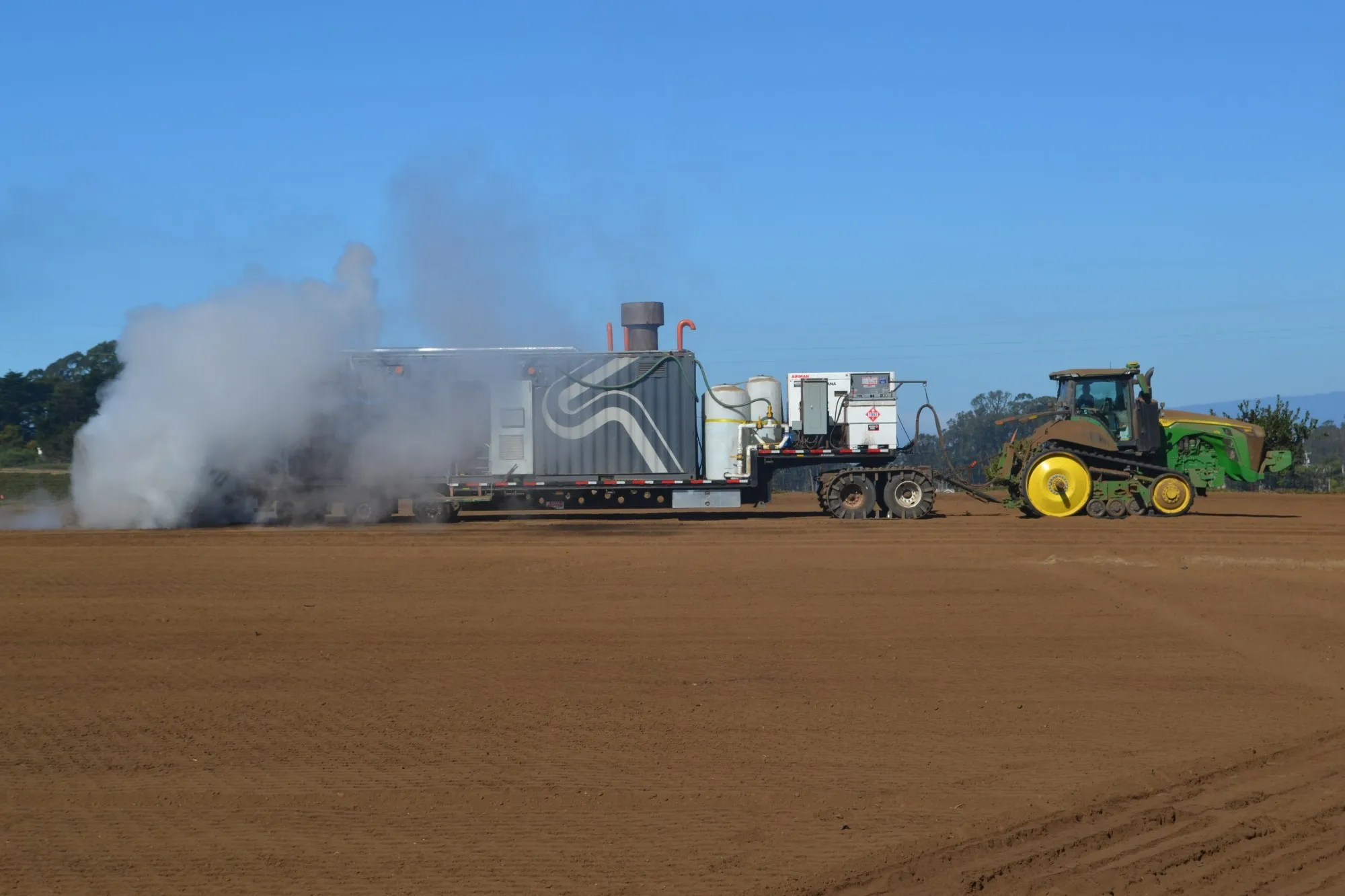
SANTA CRUZ COUNTY — Drivers winding down San Andreas Road in La Selva Beach Thursday morning were treated to an unusual site as they gazed out onto the field of Tomatero Organic Farm: a tractor pulling some kind of high-tech trailer that appeared to be emitting a lot of steam.
Read more Interpol crackdown on illegal mining, logging and wildlife trafficking leads to 233 arrests
What they saw was Santa Cruz County’s latest effort to test out a potential alternative to fumigation: the steam treatment pilot program. The county Agricultural Commissioner’s Office has partnered with Salinas company High Degree to test out the use of soil steaming — in which specialized equipment is used to inject high-temperature steam into the soil before berry crops are planted — as a potentially viable substitute for fumigation.
The goal is to explore a technology that would not have the health risks associated with pesticides but could still protect crops against pathogens and other soil-borne pests. The county has begun testing the machinery at different fields in the Pajaro Valley — some of which use conventional growing techniques and others that use organic growing methods — located near sensitive sites like schools. The county will collect data through next year on how soil steaming performs under commercial farming conditions and help the community better understand the emerging technology.
The $175,000 project was funded by the California Department of Pesticide Regulation, in partnership with Safe Ag Safe Schools and UC Santa Cruz. Jenny Broome, a plant pathologist at UC Santa Cruz who is leading a team to develop a Biologically Integrated Farming System that utilizes steam, was part of a group that secured the initial funding for a smaller steam soil machine to be used for trial periods.
“During that time, this company High Degree was able to get some venture capital funding and build their own big machine that was five times more powerful than the smaller research unit,” she said.
Broome said steam treatment is a farming method that dates back to 19th century Europe where it was primarily used in greenhouses and nurseries.
“What’s novel about this is that we’re trying to do it at a big California scale, open field, and that’s pretty challenging to pull off but we feel like we’re definitely a step closer with this new, big machine,” she said.
The program was previously tested at a mix of organic and conventional fields located near schools like MacQuiddy Elementary School, Pajaro Valley High School and Lakeview Middle School. Thursday’s site, located on Tomatero Farm‘s field at the corner of San Andreas Road and Sand Dollar Drive, was chosen by Agricultural Commissioner David Sanford because of its proximity to Renaissance High School.
“(He) highlighted it as a high priority because the school is right across the street,” said Broome.
Additionally, Broome said that despite Tomatero Farm being organic, the neighboring fields have reportedly experienced pathogens like verticillium wilt and macrophomina.
“Unfortunately, we didn’t have a direct test of the soil, but we will look for all of them,” she said. “Once we run the soil test, we’ll know exactly what we have, but that’s what we suspect because unfortunately they get moved around with cultivation equipment.”
Broome said another goal is to look at a variety of farming methods that could be used.
Read more Buckwheat growers hope new markets can help it reach more tables
“You don’t want to just rely on steam, just like you don’t want to rely just on fumigations,” she said. “A big of part of it is looking at the host susceptibility and advising the growers based on what pathogens they have, what varieties should they grow and should they avoid.”
Ryan Benson, lead engineer for High Degree, explained the process. The machinery consists of a trailer with boiling equipment pulled by a John Deere tractor. The boiler produces treated hot water that emits steam while an applicator injects it into the soil.
“It’s essentially using the steam as a heat transfer mechanism,” he said.
Benson said High Degree is collecting data and looking at ways to improve the steam machine’s operations, which will be factored into designing the next machine.
“This is more of a scale prototype so that we can test that they can do production in quantities,” he said. “Next year, we should have another machine to essentially replace this with a much smaller footprint and even increase our production.”
Broome said the data collected from the fields will be studied over the next year, based on samples from before steam was injected and again from 30 days later.
“These days, we have really good tools,” she said, likening them to rapid COVID tests, “to know exactly what pathogen is in the soil.”
Omar Dieguez, a local activist who has spoken out against the use of pesticides near schools in the Pajaro Valley, was on-site during the machine’s demonstration Thursday. He said the technology was too new to be able to weigh the pros and cons just yet but felt it was encouraging as an alternative to pesticides.
“I’m excited to see what the data’s going to come back with and see what they’re going to come up with,” he said. “It’s a step in the right direction.”
Dieguez was pleased to see it was being tested near school sites.
“That’s what we’ve been asking for, as far as activism and stopping the use of harmful pesticides just to save the children and our neighborhoods, our elders and our farmworkers,” he said.
Sanford was pleased to see the project getting started.
“It’s going to contribute to the evaluation of the technology and maybe some more innovations on how to make it more efficient in the field,” he said.
Read more Santa Ana council orders external review after video shows man being punched by police