
One part of Southern California’s housing solution is building homes where few existed previously.
Read more Retail sales up 0.9% in May from April as warm weather and cooling gas prices enticed spending
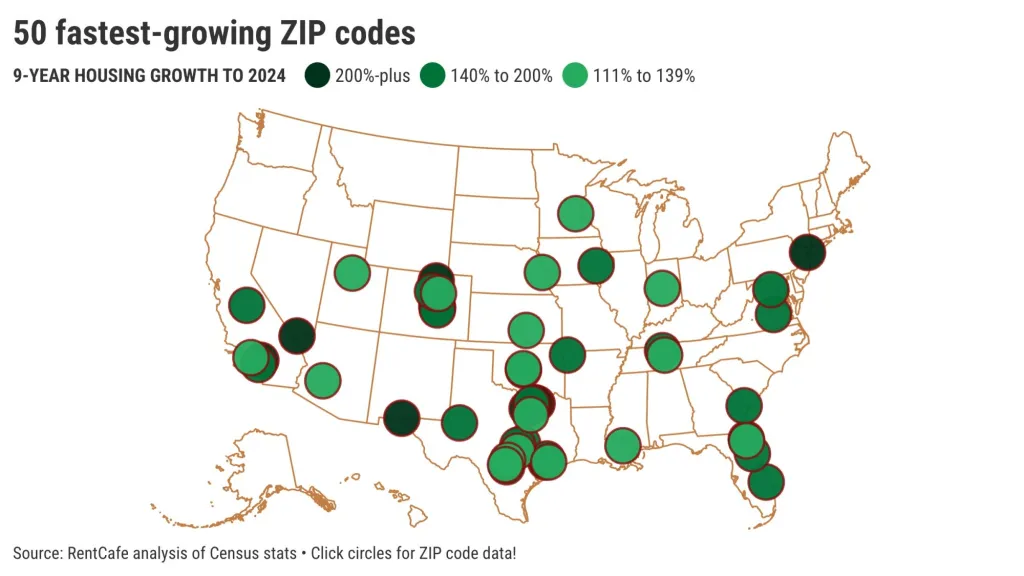
Three local examples of swift housing production were found in my trusty spreadsheet’s review of RentCafe’s ranking of what the authors called the nation’s “newest” communities – the 50 ZIP codes that added the most occupied housing between 2014 and 2023, according to an analysis of Census Bureau data.
Here in Southern California, the fast-growing trio of Chino’s 91708, Irvine’s 92618 and Los Angeles’ 90094 shows how old land can get a new life, and just how different our local housing markets can be.
Remember, RentCafe’s list focuses on places that were barely blips on the map a decade ago.
These top 50 ZIPs started with an average 3,000 homes in 2014 and ballooned to 8,000 in just nine years. Populations also took off, jumping from 8,500 to 22,000 on average.
Booming in Chino
Chino’s 91708 ZIP code took the top spot for growth. Most of this area is The Preserve at Chino, a master-planned community built by the Lewis family, long-time Inland Empire developers, on what was once dairy land. It’s an area just north of the 91 freeway and close to Prado Dam.
The housing stock grew 1,318% – yes, 14-fold – from 398 to 5,645 in nine years as its population jumped 402% to 17,308.
It’s a classic Inland Empire tale: affordable homes pulling in young families. Take a look at the demographics, based on Census Report’s census data analysis.
This slice of Chino has a median age of 33, household incomes of $109,000, and 36% of the adult population having college degrees, who are drawn to homes with a $689,000 median value, modest for Southern California. The typical residence has 3.3 people, with 73% of households being married couples.
Booming in Irvine
Irvine’s 92618 ZIP code ranks as the nation’s 20th-fastest-growing, largely thanks to the Great Park Neighborhoods that rose where the old El Toro military airbase once stood.
Housing here jumped 172%, from 9,722 to 26,470 units in nine years. The population nearly tripled, too, up 192% to 62,296.
Demographically speaking, it’s a far more upscale community than the one that blossomed in Chino.
Read more Most Americans see freedoms under threat but core to nation’s identity, poll finds
Yes, it’s also a youthful place, with a median age of 34 – but wealthier and better educated: $146,000 household incomes, with 74% having a college degree. Homes have a median value of $1.24 million. Again, it’s family-oriented: 2.6 people per residence and 65% married couples.
Booming in L.A.
At No. 50 is Los Angeles 90094, part of the Playa Vista development that turned the old Hughes Aircraft manufacturing campus into a residential neighborhood near Marina Del Ray.
Its 115% growth pushing housing stock from 3,163 to 6,786 as the population doubled to 12,127.
It’s a very West L.A. demographic, appealing to a well-to-do but slightly older crowd with few children.
The 38 median age has a $146,000 household income as 83% have college degrees. The homes are valued at a median of $1.36 million, but there are just 1.9 people per residence, and only 50% are married couples.
Stately thinking
Only one other California ZIP made this fast-growth list, Friant 93626 at No. 30.
It’s an example of how some Californians have moved far inland. This tiny neighborhood is north of Fresno, in old gold-mining country, where the Friant Dam turns the San Joaquin River into Millerton Lake.
Its 1,260 housing units reflect 144% growth in nine years as its population grew by 274% to 3,039.
By the way, California’s four ZIPs on this fast-growth list ranked it third among the states, tied with Florida. No. 1 was Texas at 17. No. 2 was Colorado at 7.
Jonathan Lansner is the business columnist for the Southern California News Group. He can be reached at [email protected]
Read more Iran will reopen Strait of Hormuz and can sell oil freely under deal with US, according to leaks
- Try Jonathan Lansner’s Substack collection of economic trends. CLICK HERE!